Mountain Park
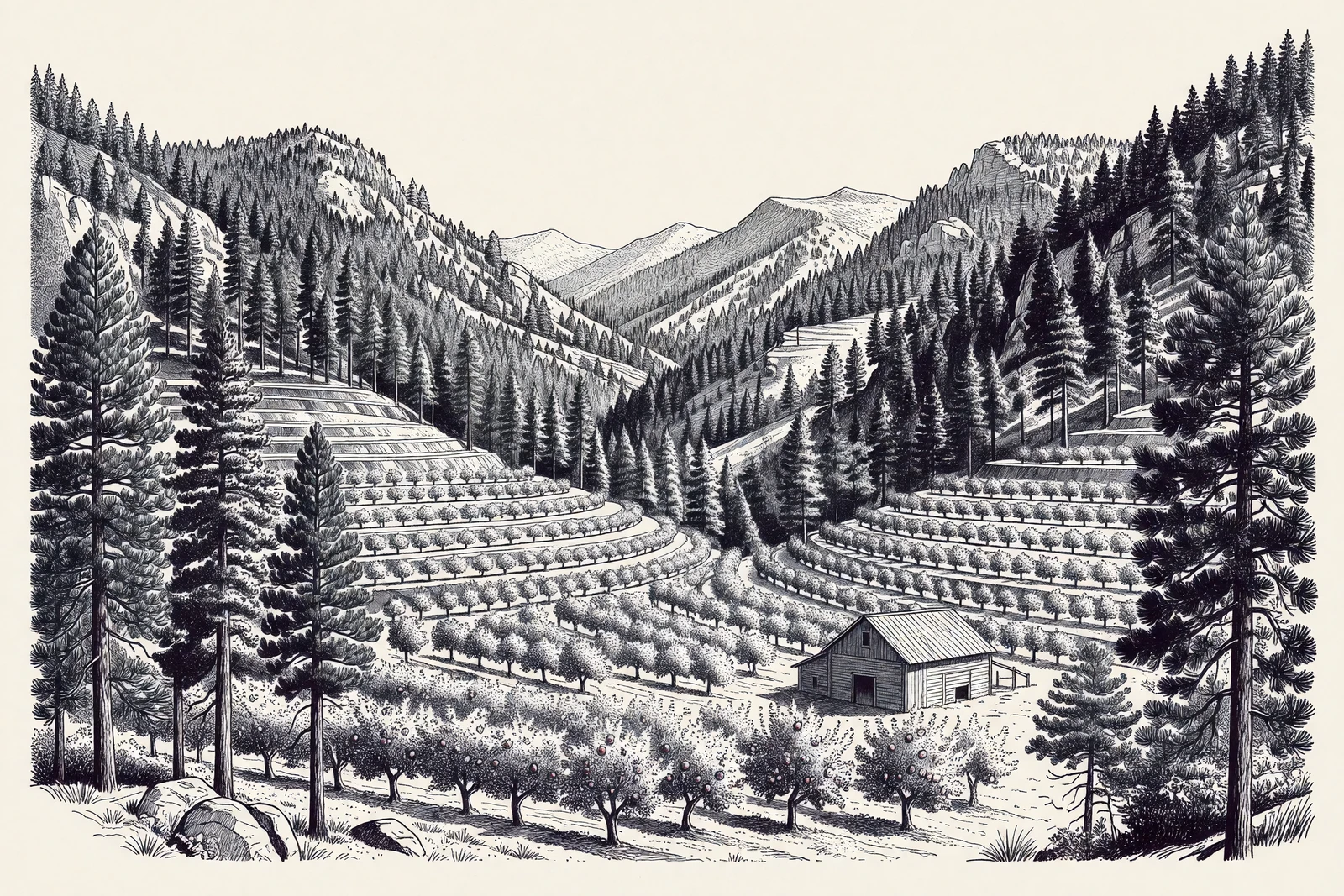
Just to the east of Alamogordo, New Mexico, a range of mountains rises abruptly from the desert floor. Their peaks reach nearly ten thousand feet altitude and they are covered by thick forest. Back in the early part of this century, a narrow road snaked its way up the canyons and ridges to the little town of Cloudcroft on top of the range. A railroad was also built in the same way to pick up the pine and fir logs and take them to a sawmill in Alamogordo. The railroad was quite unique because it utilized "switch backs" to get up the steep slopes. In some places the train would go forward a short distance and then go in reverse a short distance before going forward again. In this way it climbed a "stairway" up the mountain. A special locomotive called a "Shay" was used to power the train. This engine was specially developed for use on steep mountain grades and was used in many places around the world.
About half way between Alamogordo and Cloudcroft at about the 6,000 foot level is a small village called Mountain Park. That is where John Waldrip and Lola Davis first met. Lola lived on a goat ranch in Box Canyon not far from Mountain Park. John lived in the village and worked as a brakeman on the railroad. I really don't know just how John and Lola got acquainted but they probably met at some social activity such as a "Box Supper" or some other social affair. Both their families lived there at this time. Even John's Grandmother Crum lived in Mountain Park. John also had cousins by the dozen living in the area. John and Lola were married about 1907 and their first child, Floyd, was born in 1909.
John did not intend to make a career of railroading even though the small line was a branch of the Southern Pacific and would have offered opportunities for advancement. It was his plan to own a cattle ranch and to this end he began working. Each payday he purchased a cow. The very first one was a Jersey milk cow. This was a very significant acquisition since John hated dairy stock. He always maintained that when a cattle buyer saw a dairy animal on a ranch he would lower his offering price by a large percentage. In spite of this, "Old Jersey" became our first cow and was a real member of our family. None of her offspring were kept for breeding purposes so she did not "contaminate" the herd.
On his days off from railroading, John worked at clearing land. There were large pine stumps left in some fields and orchards and these needed to be taken out. John had a team of horses and a stump puller consisting of a heavy cable with a drum and wooden beam. The drum would be anchored down, the cable wrapped around a stump and the horses simply went around the drum pulling the beam and winding the cable to pull the stump out. While trying to pull an extra large stump one day John was in an accident. He was behind the beam which splintered and a piece of it came back hitting him in the side breaking his wrist, two lower ribs and displacing a kidney.
This was a serious accident and called for some expert medical treatment. In Cloudcroft there was a German doctor who had an excellent reputation. He had performed a number of difficult surgeries and seemed to be the best bet for treating John. So that is where he was taken. The kidney had to be removed and rib bone splinters picked out of his intestines. The doctor did a wonderful job and John fully recovered although he was always bothered by this accident. The doctor returned to Germany when World War I began and no one ever heard from him again.
With the purchase of a cow each month, John had built up quite a herd and needed a better range to graze them on. He found that range in Wills Canyon on top of the Sacramento Mountains. There was a place consisting of 160 acres with seven running springs and plenty of grazing area around it. It would be necessary to take the cattle to the desert each winter but that did not pose a big problem. So in 1911 the move was made to Wills Canyon to a log house on the ranch of Shelby Davis, father of Lola Davis Waldrip.
Sherman Emil Waldrip was born in that log house on March 11, 1912. It is rather ironic to note that Homer Davis and Sherman Waldrip tore down that old log house in 1930 to use the logs for fire wood. Anyway, we built a new frame house on our ranch about a half mile up the canyon from the Davis spread and lived there until 1920 when we moved, with the cattle, to Arizona.
John not only ran his own cattle but worked for the Circle Cross Cattle Company at the same time. The Circle Cross was owned by Oliver Lee who was a legendary figure in New Mexico at that time. He had called the bluff of Pat Garrett, who killed Billy The Kid, when Garrett ordered Lee to report to Federal authorities in El Paso. Lee told Garrett that he would respond to a summons from legally constituted officials but not from Garrett. Lee made his point stick and reported on his own at a later time and was never indicted.