Horses That Were Special
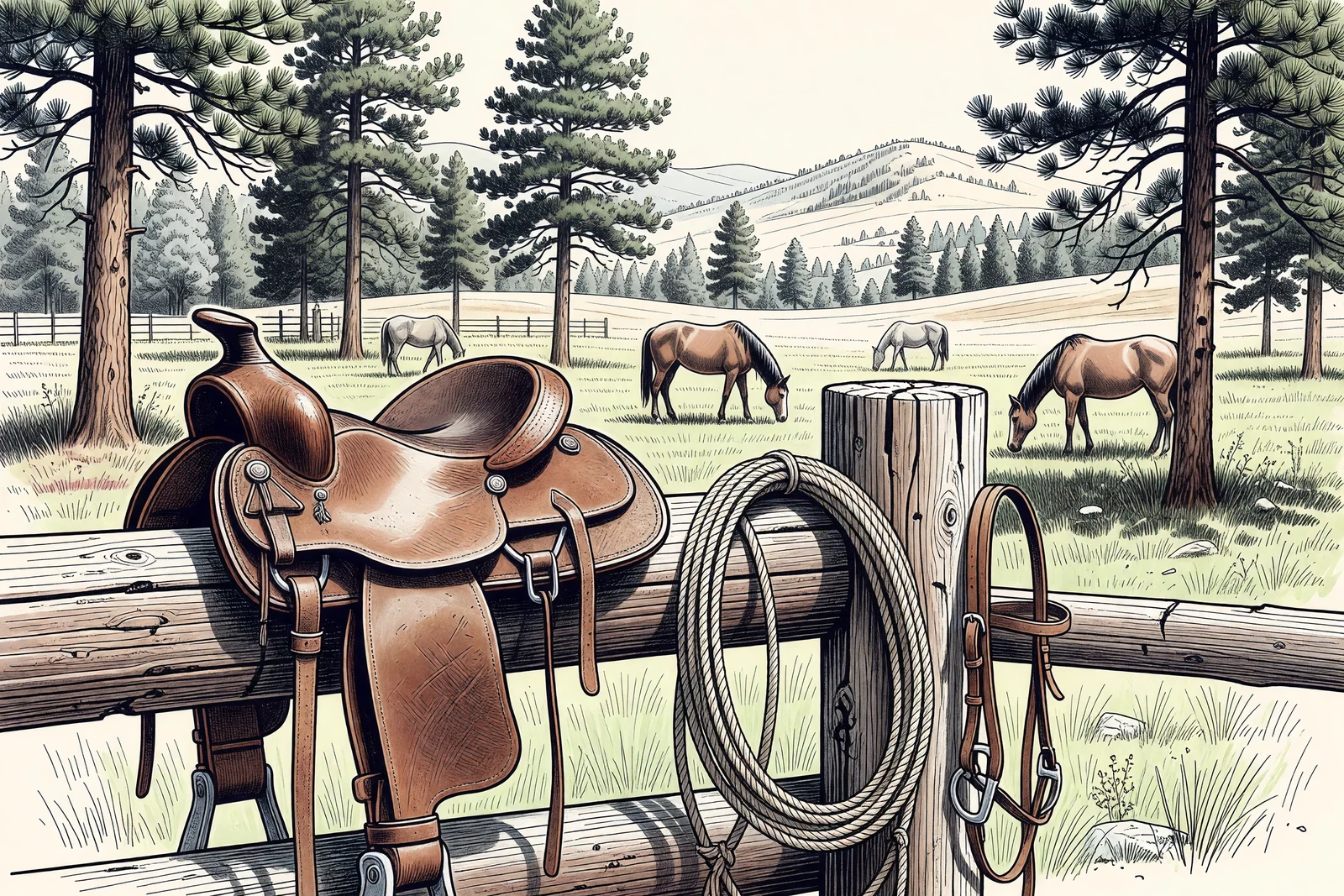
I am sure that there are many people who think that all horses look and act alike. Nothing could be further from the truth. Horses are a bit like people in that each one has a different personality and tends to do his job in a distinct way. Some are not the least bit responsive while others respond readily to their riders.
The one horse that stands head and shoulders above all others in my memory was Fox. He was the idol of our family and able to do most anything that was asked of him. Dad bought Fox and Snip, who were half brothers, from a rancher who lived on the Agua Chiquita in the Sacramento Mountains of New Mexico. Fox was about a year old when we got him and Snip was about two. At nearly the same time, Dad bought Maude, a big work mare, and he also bought Tony and Red from Marvin Lane, a horse trader. Tony and Red had unsightly brands on their right hips. Their brands were the owner's name LANE and took up most of the room on their hips. All five of these horses came to Arizona with us when we moved here in 1920. Maude and Snip were work animals. Fox and Tony were saddle horses while Red was used in both roles.
Fox, the star of the bunch, was special because of his intelligence. Dad broke him when he was very young and did not really give him a chance to pick up any bad habits. He showed great promise as a colt when it became obvious that he enjoyed driving cattle and when he quickly understood the purpose of a rope. He also became expert at cutting cattle when a herd was being held. No animal could escape him when he decided to "cut" that animal out of a herd. That understanding carried over to sheep, goats, turkeys, chickens and all groups of animals. Just show Fox the animal you wanted removed from the herd and then sit there and watch him do the job. He was really amazing.
Fox had a few irritating traits that sometimes bothered a rider. For instance he would shy at a black stump and jump sideways when he suddenly saw one. He never did this when Mother or one of the young kids was riding him. He would never make a sudden jump but was most considerate of his rider. He was just broken to ride when Floyd and I rode him to school in Cox Canyon. When we started home at the end of the day we forgot to tighten the cinch and when we leaned over the saddle turned! Off we went! Fox was understandably frightened to have the saddle under his belly so he started running up the road kicking the saddle to pieces as he went. Finally the remains of the saddle came off him and Fox came back down the road to check on the condition of his late riders. Needless to say, his riders were not in the best of shape since the saddle was a new one and we knew that a cowboy who did damage to his equipment by being careless would be held accountable. We were.
Not long after the saddle-turning incident a local character tried to buy Fox from Dad. He offered $500 which was an unheard of price when you could buy a good horse for $40 at most. Dad would not sell so the character said he would shoot Dad in the back and take Fox to Mexico. Dad took him seriously and carried a pistol the rest of his life when he was out on the range.
One could write a book about this horse but there were others who did some interesting things also. One was Chub. Now Chub was a clown. He was owned by Miss Ola and Miss Betty Young whose cattle were managed by Dad. The cowboys hated Chub because he was a pest around camp and because he was so difficult to ride due to his short steps. He probably weighed 1300 pounds but had extremely short legs and so took two steps to the other horse's one. I loved Chub because he was so intelligent and when I went out to the pasture to bring in the horses all the others ran away as soon as they saw me but Chub wouldn't move. He stayed right where I found him and would let me walk right up to him and climb on Then the show began. He would back his ears, lower his head and begin to buck being very careful not to throw me off. When we had finished his "act" we would go round up the other horses and drive them to the house. Chub had other tricks too. While driving a herd of cattle he would bite the slow ones in the rump to make them move faster. I took advantage of this by getting him to bite the ones I pointed at as we went along. This back fired though when Dad rode up to Mr. Bushman at Dry Lake and leaned over to shake hands with him. Naturally Chub thought Dad was pointing and he was supposed to bite. Mr. Bushman had a sore shoulder for some time.
I want to mention Snip who was mostly unremarkable. He simply did his job in a quiet way and could have been easy to overlook in any group of horses. He was slightly larger than most saddle horses but not as large as his partner, Maude, who died some years before Snip. We had loaned the team to Jack McKenzie for a week and Maude became sick and died. So Snip was all alone and was used with Red and other horses for various tasks. One evening Snip came to the ranch house and stood with his head over the yard gate. When Dad was getting ready to go to bed he saw Snip at the gate so he went out and did a rare thing, he petted him for awhile and Snip turned and walked away. The next morning we found Snip dead out in the pasture. Obviously he had just dropped in to say his last good bye.
Hoggie was a special case. His name came from the shape of his back. Most horses have a sway in their back where the saddle fits. Hoggie had a hump like that of a hog, thus the name "Hoggie." There was another thing that set this horse apart, at various times and places Hoggie would simply go in reverse. That is, he would just start going backward without any obvious reason. We thought he probably had eaten too much loco weed at sometime or other because any animal who ate loco might do many unexpected stunts.
Four of us were riding on a trail one winter and Otto Reasoner was riding Hoggie. The trail led around the edge of a high bank and at one place a large pine tree had fallen across it. We found it necessary to ride very close to a fifty foot drop off in order to get around the fallen tree. Just as Otto on Hoggie cleared the narrow place Hoggie had one of his "reverse" fits and ran backwards right off the bank. Down they went rolling and sliding all the way to the bottom. Luckily Otto did not get trapped under the horse but took his own way down the drop. It was a miracle that there was no serious injury. Hoggie was a bit skinned up and one stirrup was broken on Otto's saddle. Otherwise there was no damage. When you rode Hoggie you had to be prepared for one of his "reverse" fits at any time and Otto just was not prepared when Hoggie shifted into reverse.
Tony was an ordinary cow horse who did his job somewhat reluctantly but did it well enough to get by. He carried kids to school and herded cattle although he never learned how to handle a rope. That is, he just did not understand how to keep the rope tight after you roped an animal but he tolerated a rope being thrown from his back. Tony was somewhat unreliable with kids. He once ran away with Victor. He just took the bit in his teeth and down the country he went jumping ditches and bushes with Victor hanging on for dear life. He finally jumped a fifteen foot ditch and Dad caught him on the other side. Victor was just not strong enough to hold him and Tony knew it. Tony was a great swimmer but I have no idea how he came by that talent. Later in this paper I will tell how he swam Spring Creek with me during a flood.
Just a word about Mack, a raw boned hammer headed bay, whom we bought from the Rufe Russell family. Mack was probably the worst horse alive at the time. The Russell family was a poor homesteading outfit who lived on Pine Creek about three miles north of our place on the Mesas. We knew they were stealing beef from us but we also knew they had to have something to eat so we were not too vigilant in observing them. They owned Mack and he was about the only thing they did own. One day Dad rode by the Russell's and Rufe told him if he could sell Mack the family would move out of the country. Dad quickly offered him $40 for Mack and sure enough the Russells moved in the next few days. Dad said he spent $40 in order to save $200. We tried to use Mack in various jobs but did not really get any work out of him. He could hardly pull a buggy from the ranch to the school house.