The Waldrip family · from a name at the foot of a Virginia land patent, 1682, to a room in Phoenix, 2026

Whose hand made the mark

  • his mark · Michael Waldrip · Wayne County, Tennessee · 8 June 1821 · drawn here, shape not recorded

  • his brand · J F Waldrip · Young, Arizona · J F W, his initials, the F laid on its side · entry 7261, 1921 · traced from the register, which prints it as a picture

  • Waldrip website mark: modern letter W with clay cross-stroke

    website mark · introduced for this archive in 2026 · a modern project identity beside two historical marks · every claim names its source

For two and a half centuries, every trace this family left in the world was made by another hand: a clerk's, a tax assessor's, a census enumerator's, a newspaper editor's. The Waldrips appear in other people's ledgers long before they keep any of their own. Then, generation by generation, the record changes hands — a brand registered in 1920, a photograph taken in a ranch yard in 1938, a business on a Phoenix street, an hour of voices on tape, and, newest of all, a song. What follows is the whole line, told in order, from a slow tidewater river in Virginia to a crowded room in Phoenix.

Narrative excerpts by Kristopher Waldrip

  1. sourceda record, or a transcription that names it, was opened and its words carry the claim
  2. inferredno record states it; it is worked out from records or photographs that were opened
  3. unverifiedasserted by the tree, by a family sheet, or by an unopened lead; no opened record carries it
  4. tolda member of the family said it, on tape, with a name and a time; where the record has an answer, the two sit side by side

Prologue · 1682 to 1713 · New Kent County and the Chickahominy, Virginia

A line in a levy

The name enters the written record on April 20, 1682, in tidewater Virginia, where the Chickahominy winds through low tobacco country on its way to the James. On that day a patent — the crown's grant of land — issued to William and Thomas Claiborne for 545 acres at the river's fork, and seventh among the eleven persons whose transportation paid for it stands Micha. Wardrope. Under the headright system, bringing a settler across the ocean earned land for the man who paid the passage. Michael received nothing; his arrival was the currency that bought someone else's estate. The patent book itself has never been opened at this page; the grant survives in abstracts — researchers' later copies — and three independent transcriptions agree on the acreage, the fork, and all eleven names, which is as firm as a 340-year-old record gets without the original. He may appear a decade earlier still, in 1672, on York County's list of tithables — the taxable persons of each household — but that levy has never been read in the original either, so it stays a lead rather than a fact.

  1. unverified

    A Michael Wardrope was a tithable of York County, Virginia, in 1672.

    WikiTree Waldrop Name Study, citing York County levies; the page sits behind a bot challenge and was not read; the project's surname research

  2. sourced

    "Micha. Wardrope" was one of eleven persons whose transportation earned William and Thomas Claiborne a patent for 545 acres at the fork of the Chickahominy, 20 April 1682.

    Virginia Patent Book 7, p. 154, abstracted in Nugent, Cavaliers and Pioneers, vol. 2, p. 236; three independent transcriptions (WikiTree Waldrop-1015, the genealogy.com Waldrop forum, acvancestors.com) agree on the acreage, the fork and the eleven names; opened 2026-09-08; the patent book itself not opened; the research draft's page 154 corrected to 236 · https://archive.org/details/cavalierspioneer0000nuge

  3. sourced

    He did not hold that land, he was refused it. In June 1699 ninety acres in Pamunkey Neck were assigned to "Mich: Wardrope" by Fuller and Johnson. In September 1701 the House of Burgesses resolved that no patent should issue to anyone claiming inside the bounds of the Pamunkey Indians, and named him among them. Its index records the outcome in one word: rejected. A patent was obtained anyway, and in 1713 the Council ordered the Attorney General to vacate it as surreptitiously got. That is the last trace of the name in this record.

    Journals of the House of Burgesses of Virginia 1695 to 1702, p. 283, index: "Wardrop, Michael, claim of, for land in Pamunkey Neck, rejected, 283"; Executive Journals of the Council of Colonial Virginia, vol. 3, p. 360; Louis des Cognets, English Duplicates of Lost Virginia Records, p. 62. Read 2026-09-08 by two passes independently · https://archive.org/details/executivejournal_c03virg

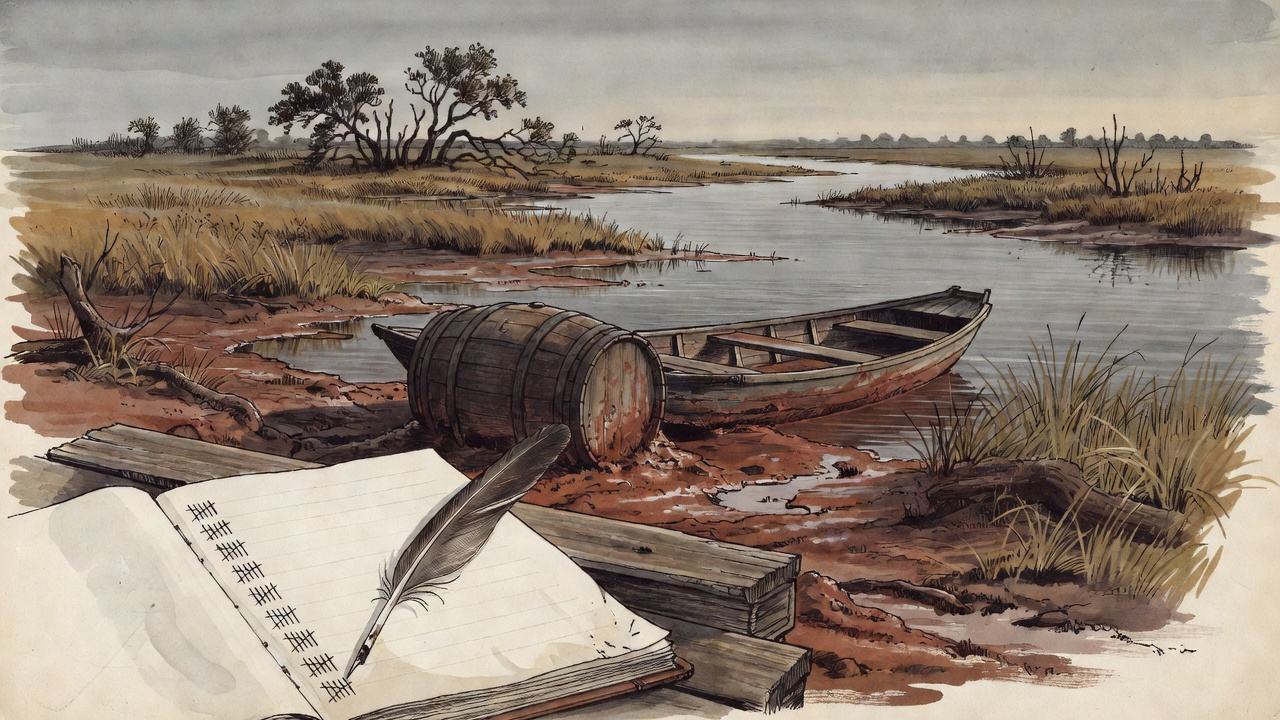
An ink and wash drawing of a tidewater river fork at dawn, a tobacco hogshead on a muddy landing, and the corner of an open ledger with tally strokes down its margin.
A drawing, not a document: the fork of the Chickahominy and a ledger margin, as an illustrator imagined 1682. No image of the patent page exists on this site because none was made.

illustration · generated 2026-09-08, xai grok-imagine-image · the plate notes · not evidence of anything

1713 to 1770

Between the tidewater and the piedmont lies a gap no document crosses. Three or four generations sit inside it, and no deed, will, bond, or list yet found puts a father and son of the name on the same page anywhere in those years. The surname persists; the connection does not. Family trees vault the gap easily — some run the line all the way back to a Joseph Waldrope said to be born in 1550, an entry with no record beneath it — but a date on a collaborative tree is a claim, not a finding, and it is left where it was found. The story resumes where the paper resumes: in the red-clay creek country of Laurens District, South Carolina.

Michael Waldrip

about 1770 to about 1835

Laurens District, South Carolina → Maury County → Wayne County → Lawrence County → Indian Creek, Wayne County, Tennessee

He could not write. Every abstract of those three papers preserves the clerk's parenthetical note that a mark was made; not one preserves its shape. The originals may still carry it — a loose paper in the Wayne County courthouse attic, two deed books in Lawrence County — and until someone opens them, the mark survives as a fact but not a figure.

No photograph of him exists. The daguerreotype reached America in the last months of 1839, the year his heirs first sold his land. There is nothing to restore and nothing has been drawn in its place.

inferred · from the deed record (heirs' first conveyance 10 December 1839) against the date the process arrived; no image of any kind in the archive for this man

Michael (his mark) Waldrip · surrendering a rented farm · Wayne County, Tennessee · 8 June 1821

The mark is recorded three times. Its shape is not. Every abstract gives the clerk's formula, "(his mark)", and none reproduces the glyph, so what is drawn above is a drawing and not his hand. The originals may still carry it: the 1821 loose paper in the Wayne County courthouse attic, and the 1827 and 1832 deed books in Lawrence County. Nobody has opened them.

  1. unverified

    On 8 June 1821 he agreed to give up "peaceable possession on the place whereon I now live" by the first of January, and signed it with his mark.

    Wayne County Loose Court Papers, Courthouse Attic, Installment 47: "I Michael Waldrip doth agree to give up pecible possession... signed Michael (his mark) Waldrip"; not opened; the project's research on this man

  2. unverified

    He made the mark again in March 1827, on an occupancy agreement witnessed by his son Abel, and again in February 1832, selling seventy acres on Shoal Creek for six hundred dollars.

    Lawrence County Deed Book C, pp. 183 to 184 (recorded 20 July 1829); Lawrence County Deed Book D, p. 194 (recorded April term 1832), "signed Michael (His Mark) Waldrip"; neither opened

  3. inferred

    His name was Michael. The forename "Richard" that the tree gives him appears in no record made while he was alive.

    from every deed, bond, roll and census 1810 to 1851 across Maury, Lawrence and Wayne counties, and the estate deeds his widow and heirs signed; the forename entered family sheets through a researcher's reading of the 1816 court docket and a neighbour, Richard Harrison Waldrop of Giles County; the project's research on this man

  4. inferred

    He was born between 1770 and 1774, in South Carolina.

    from two census age brackets, 1820 Wayne County (45 and over) and 1830 Lawrence County (50 to 59), and the Laurens County deeds of 1806 to 1807; no birth record of any kind survives

  5. unverified

    On 28 January 1807 he and John Waldrop sold 154 acres on Tweedy's Creek of the Little River to William Clark for $462, and left South Carolina.

    Laurens County, SC, Deed Book K, p. 359, No. 109, recorded 17 November 1815, "John Waldrop and MICHAEL WALDROP JR. to Wm. Clark"; not opened

  6. sourced

    By June 1809 he was in Maury County, Tennessee, one of twenty hands ordered to keep the Fountain Creek road open from the Hurricane to Lindsays.

    WikiTree Waldrop-470 (the profile of James Waldrip), opened 2026-09-08: "In Jun 1809 he and Richard Michael Waldrip were among '20 hands to keep open that part of Fountain Creek Rd from the Hurricane to Lindsays' in Maury Co."; the county minute itself not opened; the project's verification notes

  7. unverified

    On 8 January 1810 he gave bond to marry Rebecca Brown. Absalom Brown stood bondsman.

    Maury County, TN, Marriage Records, vol. 1 (1808 to 1838), County Clerk's Office, Columbia; FamilySearch film 2,281,745: "Know all men, that we Michael Waldrip & Absalom Brown of the county of Maury and State of Tennessee, are held and firmly bound"; not opened

  8. unverified

    From 24 September 1813 to 18 May 1814 he rode in Captain McKinney's company of cavalry under Colonel Dyer, in the Creek War.

    Jill Garrett, War of 1812 Soldiers of Maury Co., TN, p. 196, from National Archives RG 94: "Michael Waldrop served in Capt. A. McKinney's company, cavalry, Col. R. H. Dyer"; not opened

  9. unverified

    In May 1816 he and an older Michael were before the Maury County court over an affray with the Pillow family. A jury found the younger man not guilty; the case against the elder was dropped.

    Maury County Court of Pleas and Quarter Sessions, Minute Book 2A and 3, pp. 199, 202 (Carol Wells abstract): "State vs. Michael Waldrup, Junior... upon oath do say that the defendant is not guilty" and "State vs. Michael Waldrup Sr.... nolle prosequi"; not opened. The older Michael is the best candidate for his father, and nothing on paper says so.

  10. unverified

    On 1 March 1833 he bought eighty acres on Indian Creek in Wayne County from Samuel Haggard. By the 1836 tax list his widow Rebecca is assessed for it and he is gone.

    Wayne County Deed abstracts (James A. Gray, Deed Book 1, 1820 to 1838); 1836 Wayne County Tax List, Civil District 8: "WALDRIP, Rebecca: 80 acres"; neither opened

  11. inferred

    He died on that land between March 1833 and December 1839, intestate. The tree's 1835 is a reasonable guess with nothing behind it.

    from the 1833 purchase, the 1836 assessment of the widow, and the heirs' first deed of 10 December 1839 conveying land "that Michael Waldrip died possessed of"; no death record, no stone found

  12. unverified

    On 5 November 1842 three of his children, living in Mississippi by then, sold their share of his eighty acres to John White for "two second rate cows and a calf".

    Tippah County, MS deed, recorded Wayne County, TN, Deed Book G, pp. 115 to 117: "We, Able Wallrip and Anderson Wallrip and Carline Wallrip have this day bargained and Sold... all our interest in an 80 acre tract that Michael Wallrip died possessed of... consideration of two second reate cows and calf"; not opened. Anderson is the boy in chapter II.

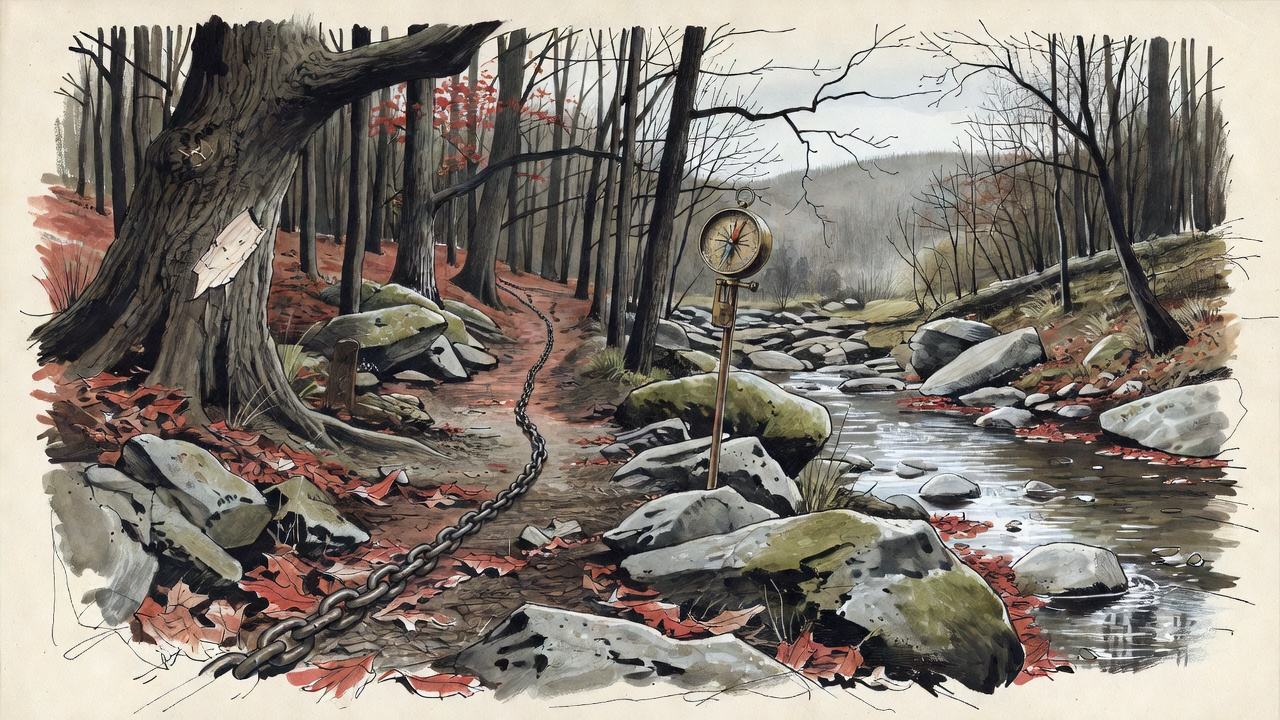
An ink and wash drawing of a surveyor's line cut through bare hardwood forest: a blazed oak, a Gunter's chain across leaf litter, a compass on a staff, a shallow creek over limestone.
A drawing of the country, not of the man: the Chickasaw Cession line being run above Shoal Creek, as an illustrator imagined about 1816. Lawrence and Wayne counties were laid out on that cession in 1817; he bought on Chisolm's Fork of Shoal Creek in 1826 and on Indian Creek in 1833.

illustration · generated 2026-09-08, xai grok-imagine-image · the plate notes · not evidence of anything

Everything on this page about him was written by someone else. He could not have read a word of it.

Anderson Marion Waldrip

5 January 1827 to 10 March 1897

Lawrence County, Tennessee → Tishomingo County, Mississippi → Smith County → Coleman and McCulloch counties → Nolan County, Texas → Fresnal Canyon, New Mexico Territory → died at Robert Lee, Texas

Rebecca took the younger children south across the state line into Tishomingo County, in the hill country of Mississippi's northeast corner — Chickasaw land ceded at Pontotoc less than a decade before. The 1840 census finds her heading her own household there, with Anderson among the boys aged ten to fifteen; the Merchant families are enumerated on the same page. On November 5, 1842, three of the children, Abel, Anderson, and Caroline, sold their shares of their father's Tennessee eighty acres to John White for the price the deed itself records: two second-rate cows and a calf.

East Texas was filling with cotton rows, so Anderson went the other way — west, to open range on the upper Colorado. The 1870 census counts him raising cattle in Coleman County, a county of 347 souls. When McCulloch County was organized next door in 1876, the seat of settlement lay on ground already called Waldrip's Ranch, and in 1879 a post office opened under the name Waldrip. The county history names the ranch rather than the man, so the identification rests on inference — but inference with paper under it: the census and land records put Anderson on that ground, and an 1885 postal directory lists him as storekeeper and postmaster of Waldrip, Texas. For the first time in two hundred years, the family name was on a map. The 1880 census caught the household at its fullest — Anderson at fifty-three; his son George Thomas, twenty-one, already a married cattle raiser; a grandson, Julian, eight months old — three generations under one roof on the Colorado.

  1. sourced

    A third-class headright for 320 acres in Smith County, Abstract 1058. It was patented on 25 July 1855 to E. H. Barber, as assignee: Anderson earned the certificate and sold it before it issued.

    Texas General Land Office land grant 44970, opened 2026-09-08: "Original Grantee: Waldrip, Anderson M · Patentee: Barber, E H · Patent Date: 25 Jul 1855 · Patent Number: 1001 · Patent Volume: 9 · Acres: 320" · https://www.glo.texas.gov/archives-heritage/search-our-collections/land-grant-search/land-grant/44970

  2. sourced

    When McCulloch County was organised in 1876 the site was part of Waldrip's Ranch, and a post office opened as Waldrip in 1879. The Handbook names no individual, so which Waldrip the place is named for is an inference from the census and land records, not something the entry says.

    Handbook of Texas Online, "Waldrip, TX", opened 2026-09-08: "The site was part of Waldrip's Ranch when the county was organized in 1876. A post office opened in 1879." Anderson appears as storekeeper and postmaster in the Texas post office directory printed in Freie Presse fur Texas, 18 September 1885. · https://www.tshaonline.org/handbook/entries/waldrip-tx

  3. sourced

    The sheep suit was D. N. Lee against Yandell, Gray and Waldrip on a promissory note. An attachment was levied on Waldrip's flock, he pleaded in reconvention, and the jury found for the defendants and gave him damages. The appeal reversed and remanded.

    Fort Worth Daily Gazette, 4 November 1887, page 3, reporting the Commission of Appeals; also Portal to Texas History. Reported at 69 Tex. 34. The two transcriptions differ on the damages figure, one reading $750 and the other $570, so the amount is not asserted here. · https://www.loc.gov/resource/sn86064205/1887-11-04/ed-1/?sp=3

  4. unverified

    The tree gives a burial about 12 March 1897 at Robert Lee. No stone is attested: the complete 1990 survey of that cemetery lists no Waldrip and no Graham at all.

    Coke County Cemeteries Epitaphs and Dates, Copeland and Smith, 1990, read A to Y on 2026-09-08; Find a Grave 42913868 carries a portrait, not a gravestone. The death on 10 March 1897 at his daughter Kate's is corroborated; the inscription this page used to quote is not.

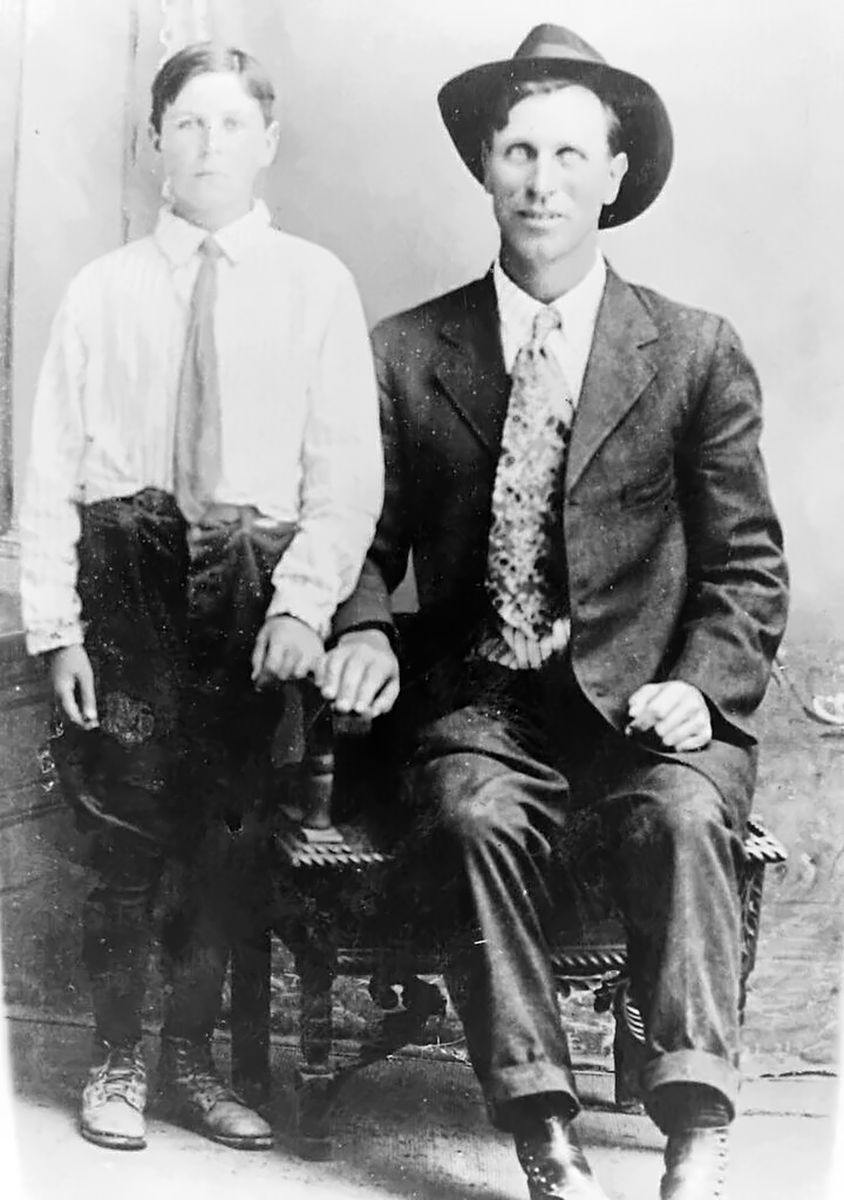
A studio portrait: a seated young man in a sack suit, patterned tie and wide-brimmed hat, with a boy of about twelve in a white shirt standing beside him with a hand on the chair.
The family album captions this "possibly Anderson Waldrip". It is the only candidate image of the man the town is named for, and the page is careful rather than eager with it.
  1. unverified

    The seated man is Anderson Marion Waldrip.

    family caption, MyHeritage export, file possibly-anderson-waldrip_2094481718; nothing written on the print; the family's photographs, supplied 2026-09-08 (private); restoration parameters and source checksums held with them

  2. inferred

    The clothing and the man's age argue against it. Anderson was sixty in 1887. The sitter reads as thirty; the suit and hat read 1890s. A likelier reading is George Thomas, born 1858, with his son John Franklin, born 1882, at about twelve: around 1894.

    from the print itself against the tree's dates; the project's note on the photographs. Writing on the back of the original, or the studio imprint on the mount, would settle it.

  3. sourced

    Restored without a model: contrast stretch, denoise, dust inpaint of a few hundred pixels, sharpen. Nothing was invented.

    the family's photographs, supplied 2026-09-08 (private); restoration parameters and source checksums held with them, "generative": false, method "percentile stretch, CLAHE, non-local-means denoise, dust inpaint, unsharp mask, lanczos x2"; opened 2026-09-08

III · 1807 to 1920 · every move on this map was forced, and the record says why

The road to the Rim

The route of the direct line from Laurens District, South Carolina to Young, Arizona, drawn over the outlines of the southern states180718101833184218551876188519051920194116821897

Laurens 1807 · Maury 1810 · Indian Creek 1833 · Tishomingo 1842 · Smith County 1855 · Waldrip's Ranch 1876 · Nolan 1885 · Fresnal and Mountain Park 1905 · Young 1920 · off the line, drawn hollow: York County 1672, Robert Lee 1897, and Aravaipa 1941, where George Thomas stopped after his son had gone north

  1. Tweedy's Creek, Laurens District, South Carolina · 1807

    Sold, and left

    The Cherokee and Chickasaw treaties of 1805 and 1806 opened the central basin of Tennessee. Carolinians went west over the Gap and down the Trace by the thousand. Michael and John Waldrop sold their inherited 154 acres on the Little River in January 1807 and were road hands in Maury County within two years.

    1. unverified

      A 1806 survey and the January 1807 deed on Tweedy's Creek.

      SC Dept of Archives and History, State Plat Books S213192, vol. 41, p. 115; Laurens County Deed Book K, p. 359; not opened

  2. Maury, Wayne and Lawrence counties, Tennessee · 1810 to 1835

    A bond, a war, three farms

    Married in Maury in 1810. Cavalry against the Creeks in 1813. A quarrel with the Pillows, the richest family in the county, in 1816, and then a move to the new counties on the Alabama line. He farmed Shoal Creek, then Indian Creek, and died there.

    1. sourced

      1820 Wayne County census: two boys under ten, two of ten to sixteen, one man over forty-five, four girls under ten, and three older females including Rebecca.

      1820 U.S. Census, Wayne County, TN, p. 325B, NARA M33 Reel 122, image opened 2026-09-08: "Michael Waldrop 220001/41110". The project had cited Roll 125, which is Robertson, Smith and Williamson. · https://archive.org/details/populationsc18200122unit

  3. Tishomingo County, Mississippi · 1839 to 1842

    The widow goes south

    Rebecca took the minor children across the state line into the Chickasaw lands ceded at Pontotoc in 1832. From there, in 1842, three of the children sold their shares of the Tennessee farm for two second-rate cows and a calf.

    1. sourced

      1840 census, Tishomingo County: Rebecca Waldrip heads the household, with Anderson among the boys of ten to fifteen. The Merchant families are neighbours on the same page, ten years before Anderson turns up living with James B. Merchant in Texas.

      1840 U.S. Census, Tishomingo Co., MS, page 229 line 11, NARA M704 roll 219, image opened 2026-09-08. The project had cited page 228, which holds the Dilworth households. · https://archive.org/details/populationsc18400219unit

  4. Smith County, Texas · 1847 to 1855

    Three hundred and twenty acres

    Texas joined the Union in December 1845 and paid for settlers in land. Anderson and two brothers were in East Texas by 1847. A single man's third-class headright was 320 acres; he got it, married Mary Ann Martin in 1855, and sold it.

    1. sourced

      1850 census, Smith County: "Anderson M. Waldrup 23 M Farmer Tennessee", in the household of James B. Merchant. His brother Andrew B. Waldrup, 28, is farming two doors away.

      1850 U.S. Census, Smith Co., TX, page 42B, dwelling and family 8, image opened 2026-09-08. The project had cited page 42A, family 188 and the occupation laborer; family 188 is John Welch, and the record says Farmer. · https://archive.org/details/populationschedu0915unix

  5. The upper Colorado, Coleman and McCulloch counties · 1867 to 1880

    A name on the map

    East Texas filled with cotton; he went west to open range on the Colorado. In 1870 Coleman County had 347 residents and he was raising cattle in it. When McCulloch County organised in 1876 the site was Waldrip's Ranch. In 1880 the census counts three generations in one house: Anderson, George Thomas at twenty-one, and a grandson eight months old.

    1. unverified

      "A. M. Waldrip, age 53, Farmer, b. TN, parents b. SC; George T., age 21, son, married, Cattle Raiser, b. TX; Mary E., daughter-in-law, age 17; Julian, grandson, age 8/12."

      1880 U.S. Census, McCulloch Co., TX, Precinct 4, ED 107, p. 558D, family 28, NARA T9 roll 1317; not opened

  6. Sweetwater, Nolan County · 1883 to 1887

    Sheep, a suit, and the die-up

    Barbed wire and falling prices squeezed the open range, so he tried sheep. The partner sued in 1885 and won half the note. Then the drought of 1886 to 1887 and the winter die-ups emptied the country of stock. Ruined for range in Texas, he went west with Mary Ann and the grown children.

    1. unverified

      Nolan County District Court, case 0090, 1885: 1,200 sheep, D. N. Lee against A. M. Waldrip.

      Nolan County District Court Civil Case Files, case 0090, p. 418; not opened

  7. Fresnal Canyon, Sacramento Mountains, New Mexico Territory · 1890s

    The homestead nobody has opened

    Family letters and a later homestead file put Anderson and Mary Ann near Fresnal in the 1890s, and say she completed the claim after he died. The route stops here because the record says so; the mark is open because the file itself has not been read.

    1. sourced

      A. M. and Mary Ann Waldrip settled near Fresnal, Otero County, and after his death she completed the homestead in her own name.

      BLM General Land Office patent, Las Cruces, 20 November 1899, Homestead Certificate 1348: "the claim of Mary A. Waldrip has been established and duly consummated... containing one hundred and sixty acres... William McKinley, By the President" · https://glorecords.blm.gov/

  8. Mountain Park, on the Alamogordo and Sacramento Mountain Railway · 1905

    The timber camp

    The Eddy brothers' railway climbed into the Sacramentos in 1898 for one reason: ties and mine timbers for Phelps Dodge. It hired sawyers, teamsters and camp labour by the hundred. The newspaper says exactly why the Waldrips went up the mountain.

    1. sourced

      "George Waldrip's family will move to the logging camp for the summer. Mr. Waldrip and two sons are employed there."

      The Alamogordo News, 22 April 1905, page 3, under the local heading MOUNTAIN PARK; opened 2026-09-08 at loc.gov. The citation carried here said page 7; the issue has four pages. · https://www.loc.gov/resource/sn92070566/1905-04-22/ed-1/?sp=3

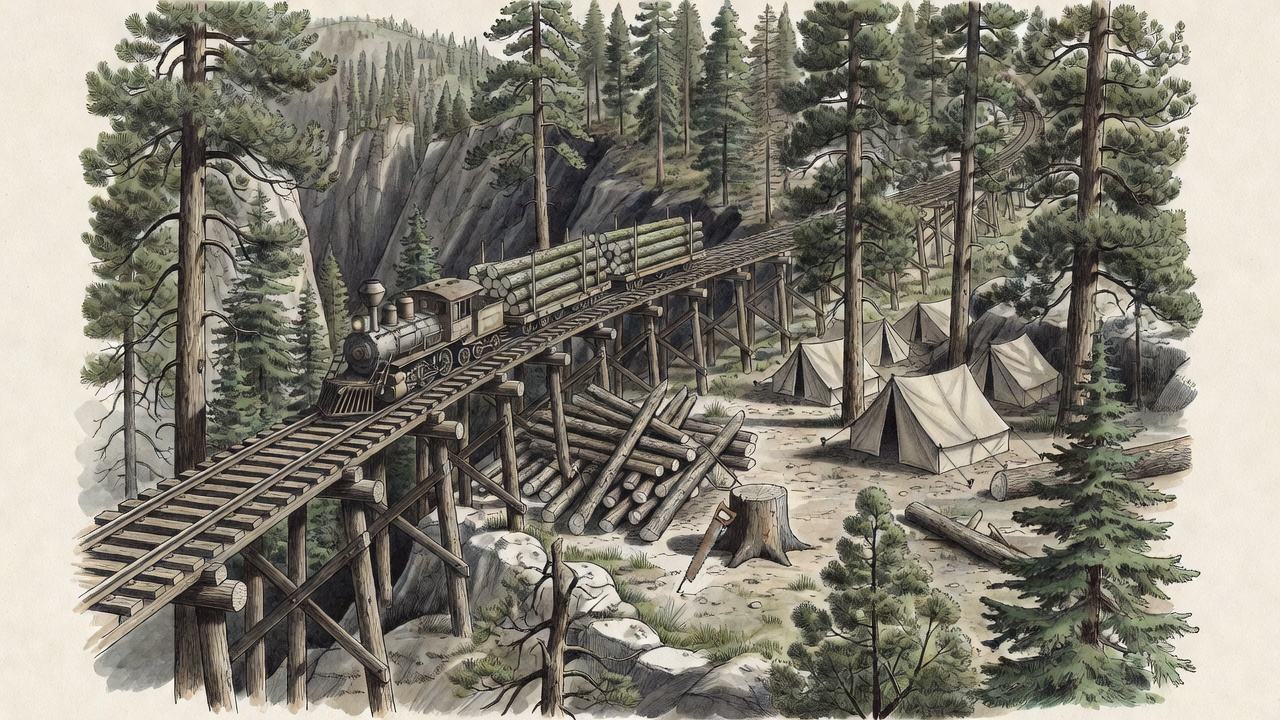
    An ink and wash drawing of a logging railway: a curving timber trestle in a pine canyon, a small locomotive with two flatcars of logs, hewn ties, a crosscut saw on a stump, canvas tents among the trees.
    A drawing of a kind of place, not a photograph of this one. The locomotive came back as a tender engine rather than a saddle tank; it is a drawing of a kind of engine.

    illustration · generated 2026-09-08, xai grok-imagine-image · the plate notes

  9. The same mountains, as the family tells it

    The stump puller

    told Diana Deen 07:26 transcript only

    07:26John Franklin Waldrip, who is Melvin and Janice and Marvin and Tommy's grandfather and a few others who might be in the room, he actually worked on the railroad, no surprise, right, in New Mexico, and he was a brakeman on the railroad.

    07:43And on his days off from railroading, he worked at clearing land. There were large stumps, pine stumps left in some fields and orchards, and these needed to be taken out.

    07:55And so John had a team of horses and a stump puller consisting of a heavy cable with a drum and a wooden beam.

    08:12And while trying to pull an extra large stump one day, John was in an accident, and he was behind the beam, which splintered, and a piece of it came back hitting him in the side, breaking his wrist, two lower ribs and displacing a kidney.

    08:35Jesus, please help me, and let me live long enough for my sons to take over.

    08:50He was rescued and treated by a German doctor who just happened to be in that little town.

    09:02After that, the doctor returned to Germany just before World War I and never was heard from again.

    told · Diana Deen, 07:26 to 09:21, the family's recording of the service, 3 January 2026 (private); machine transcript, whisper large-v3-turbo; the transcriber hears the surname as Waltrip here and the family name is corrected throughout, every change listed in the project's list of transcript corrections; opened 2026-09-08
    told unverified

    agrees: a railroad in New Mexico, a Waldrip working on it. The stump, the beam and the doctor are the family's alone, and the page does not need them checked to keep them.

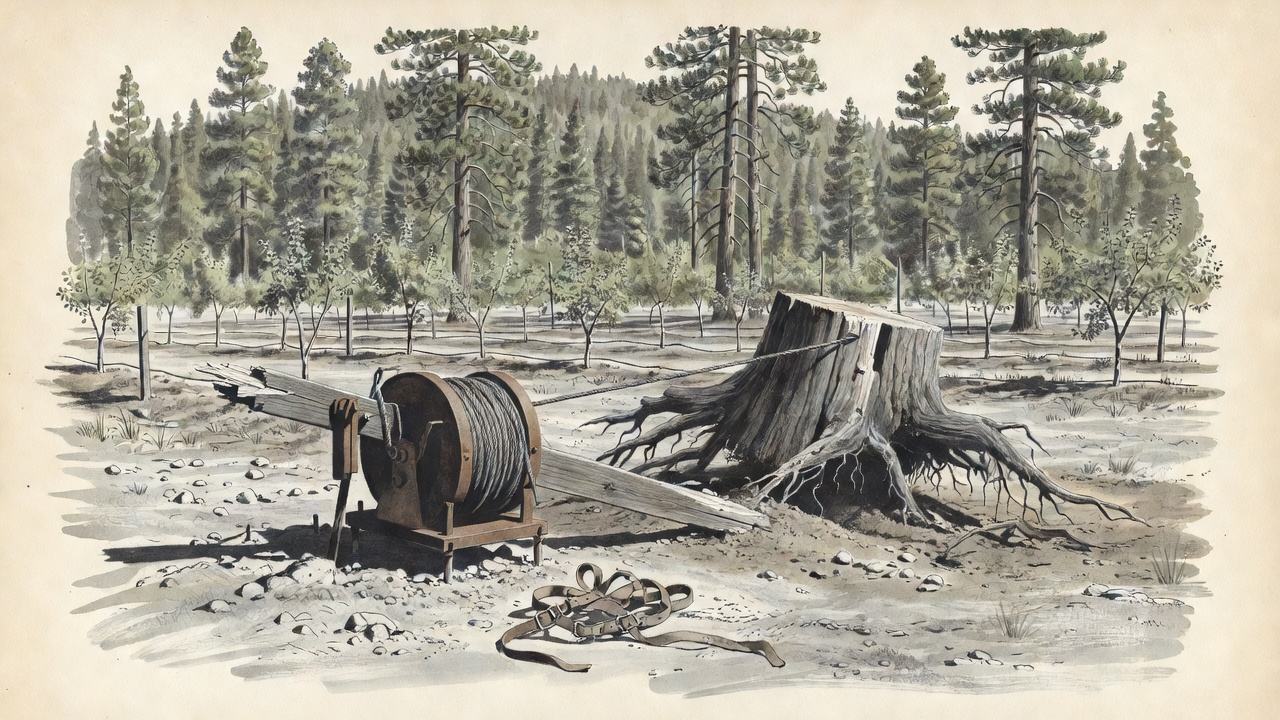
    An ink and wash drawing of a horse-powered stump puller in a cleared orchard: an iron drum wound with cable, a long wooden sweep beam splintered at one end, and a huge pine stump torn half out of the ground, with rows of young fruit trees and pine forest behind.
    A drawing of the rig in the story, not of the day. No horses and no man, on purpose: the drawing is of the telling, and a drawn John Franklin would be taken for him.

    illustration · generated 2026-09-08, xai grok-imagine-image · the plate notes

  10. High Rolls, 1910 · Aravaipa, near Winkelman, Arizona · 1941

    George Thomas goes down to the river

    Mary Emily Rhoades, his wife of thirty-two years, died at High Rolls on 10 July 1910. He left the mountains for the mining country on the lower San Pedro, and died at Aravaipa on Christmas Day 1941, at eighty-three. His son had gone the other way years before, north into Pleasant Valley, which is why the next chapter is dated earlier than this one and why Aravaipa sits off the line on the map rather than on it. He is buried at Mountain View, on the Hayden and Winkelman line, which the tree had misspelled and mislocated.

    1. unverified

      Died 25 December 1941, Aravaipa, Pinal County; buried Mountain View Cemetery, 202 AZ-177, Hayden.

      Arizona Dept of Health Services, State Certificate of Death (1941); Inventory of Historic Arizona Cemeteries; Find a Grave 93100190; not opened

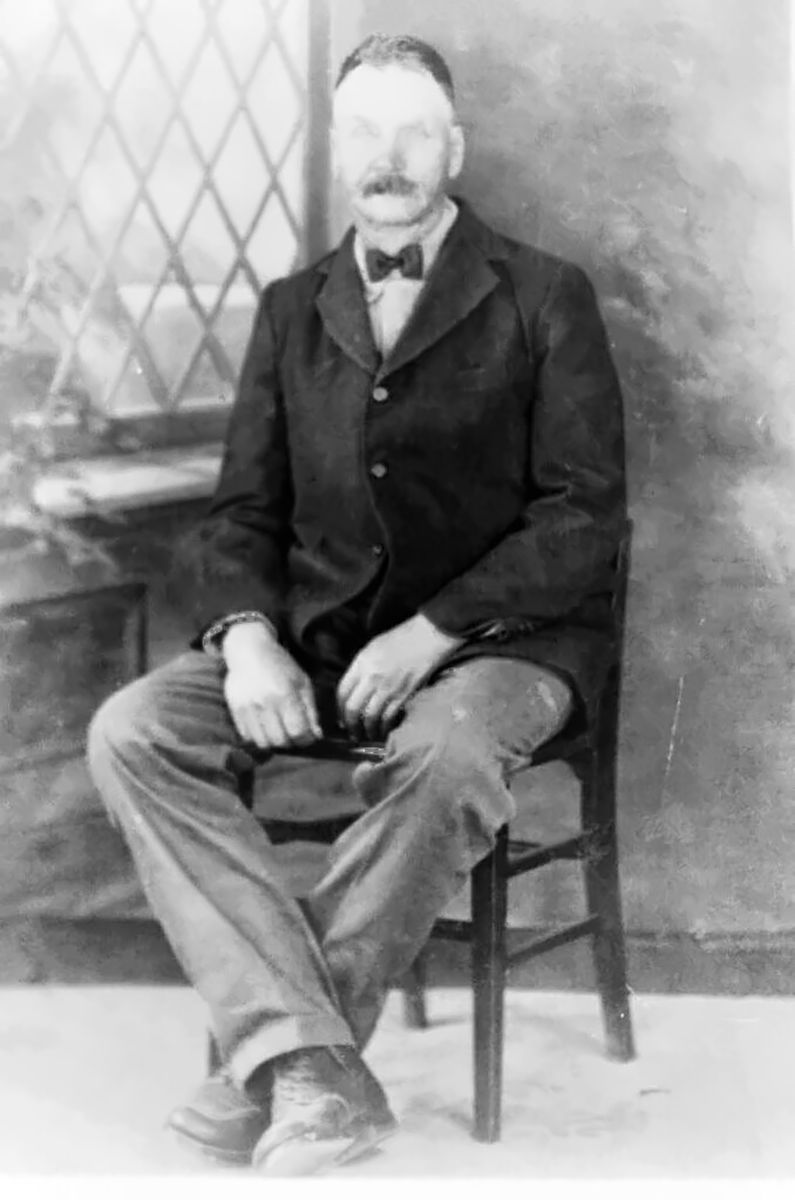
    A seated studio portrait of a man with a heavy moustache in a dark sack coat, bow tie and light trousers, hands on his knees, a lattice window painted on the backdrop behind him.
    George Thomas Waldrip, in a studio, undated. The family caption names him and nothing on the print does; the print is a copy of a copy with the highlights gone.

    inferred · family caption george-t-waldrip_2094480326 against the 1938 frames below; restored non-generatively, the family's photographs, supplied 2026-09-08 (private); restoration parameters and source checksums held with them

  11. Pleasant Valley, at Young, under the Mogollon Rim · 1917 to 1920

    His own mark

    Pleasant Valley had been emptied by the Graham and Tewksbury feud and re-let by the Forest Service as grazing allotments. John Franklin drove his stock up from the desert into it. By 1917 Floyd was at Young Elementary. In May 1920 the state recorded a brand in his name. A hundred years after his great-grandfather made a mark beside a name he could not write, this man designed a glyph, put it on paper at the state capitol, and burned it into hide. It is his own initials, J F W, with the F laid on its side. The man whose great-grandfather could not write his name burned all three of his into hide.

    The 1921 Arizona brand register, printed page 50: the brand as the letters J F W with the F laid on its side, beside entry number 7261 and the words J F Waldrip, Young.
    Entry 7261. The brand is printed as a picture because a brand is a shape, and the shape is J F W with the middle letter turned on its side, which the trade calls a lazy F. Read out by Rick Waldrip, who took one look and said it was too complex to be real, and was right that nobody burns an arbitrary figure.

    sourced · Brand book of the state of Arizona, Live Stock Sanitary Board of Arizona, 1921, printed p. 50, scan leaf 56; opened 2026-09-08 at archive.org/details/brandbookofstate00liverich · https://archive.org/details/brandbookofstate00liverich

    1. sourced

      "J F Waldrip / Young / c ls-rh h ls-t", entry 7261, with the brand printed as a glyph.

      Brand book of the state of Arizona, 1921 (archived reader), printed p. 50, scan leaf 56, opened 2026-09-08. The book contains no letters "WX"; the expansion of the placement codes is not asserted because the legend page has not been read.

    2. unverified

      1930, Young Precinct: "John F. Waldrip, Head, age 48... Stockman, Cattle Ranch, Own Account; Lola M., Wife, age 41; Floyd R., Son, age 21, single, born New Mexico, Laborer on Cattle Ranch".

      1930 U.S. Census, Gila County, AZ, Young Precinct 17, ED 4-48, p. 1B, family 16, NARA T626; not opened

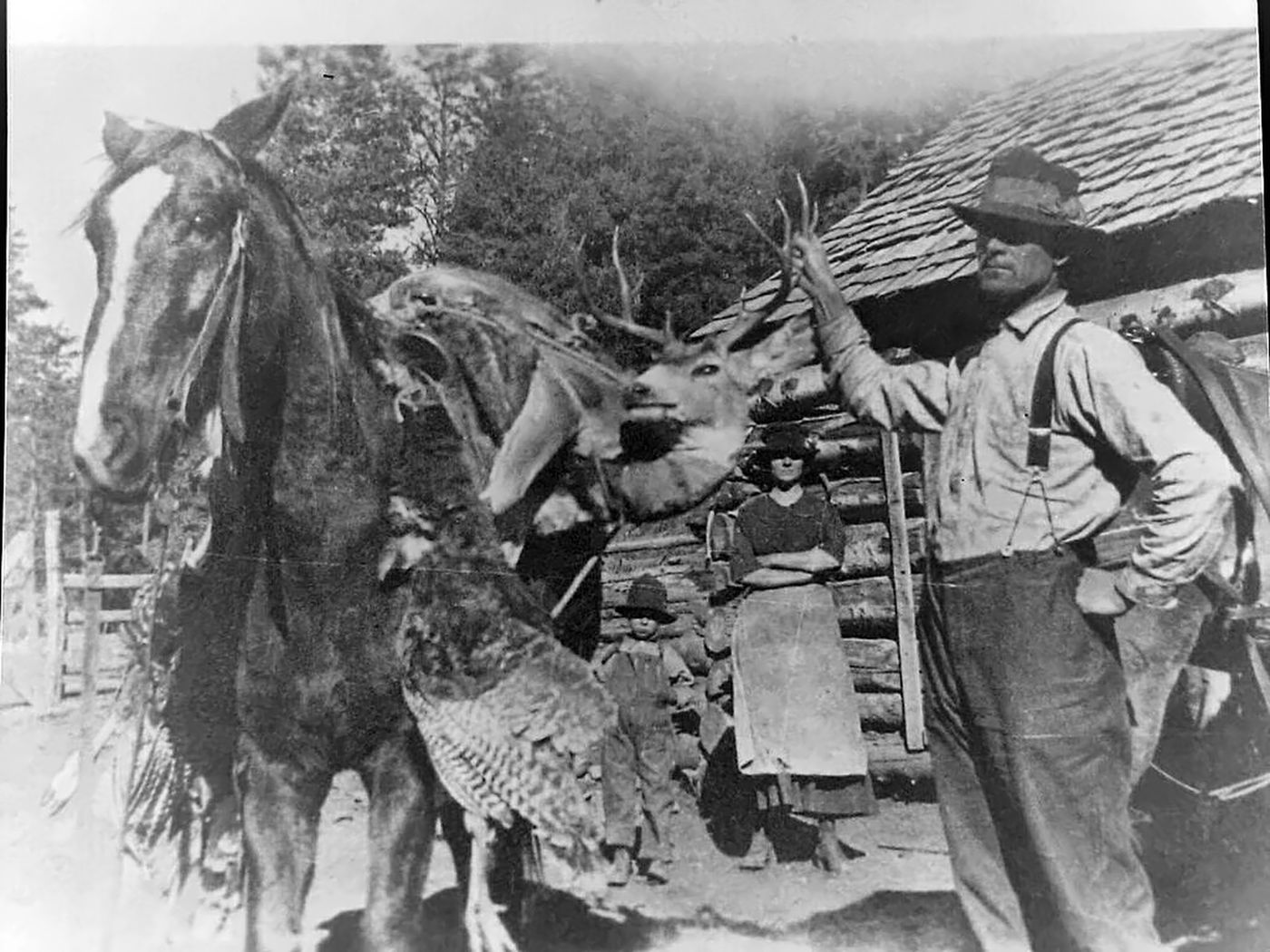
    A man in a hat, suspenders and work shirt stands beside a horse packed with a buck deer and a wild turkey, in front of a log house; a woman in an apron and a small boy stand in the doorway.
    "John Waldrip, home from hunting", the family's caption. A log house under the Rim, a horse, a buck and a turkey; the woman and the boy are not named on the print.

    unverified · family caption john-waldrip-home-from-hunting_2094481300; no date on the print; restored non-generatively

1938

Young, Arizona · the first image the family made of itself

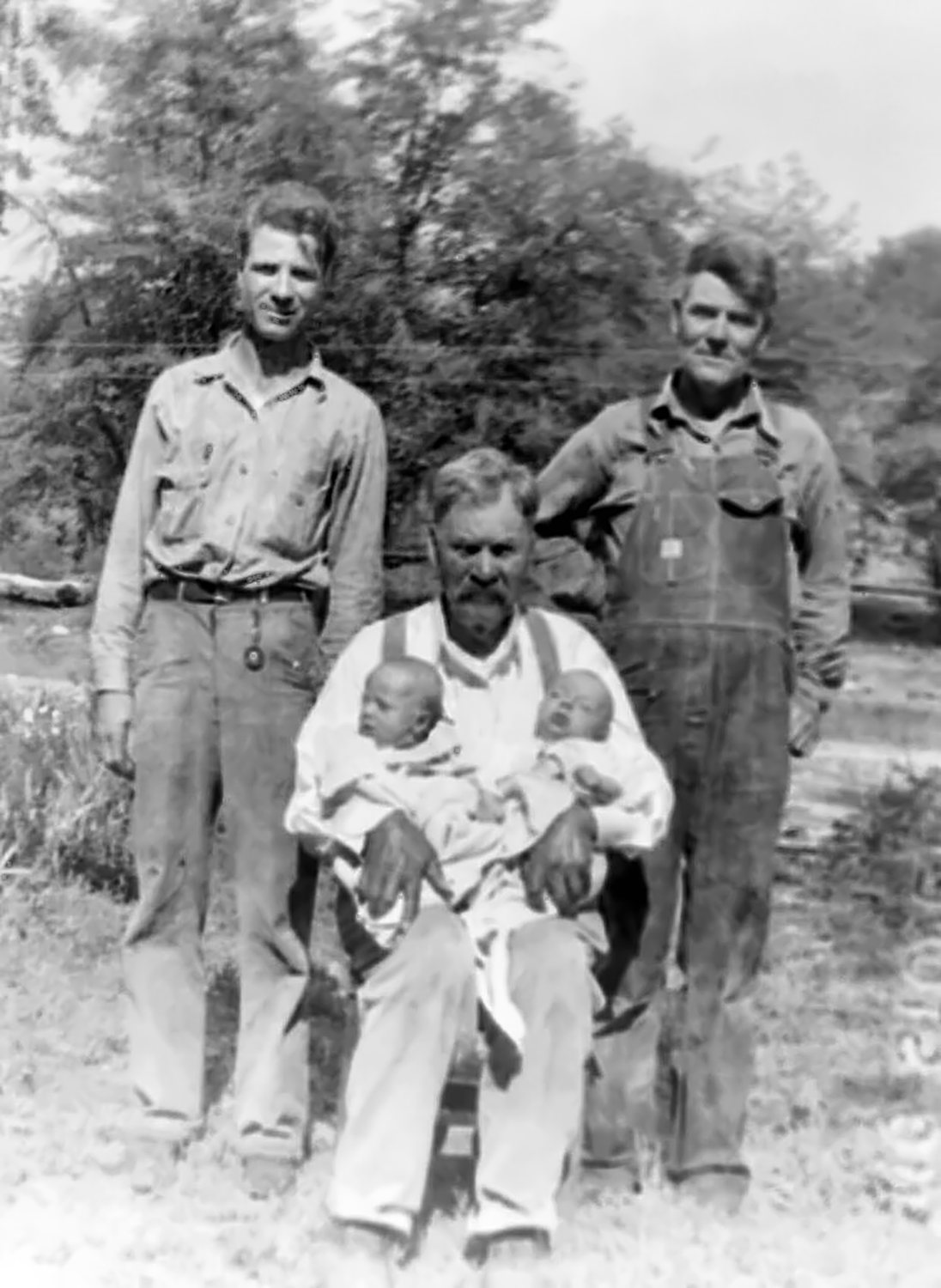
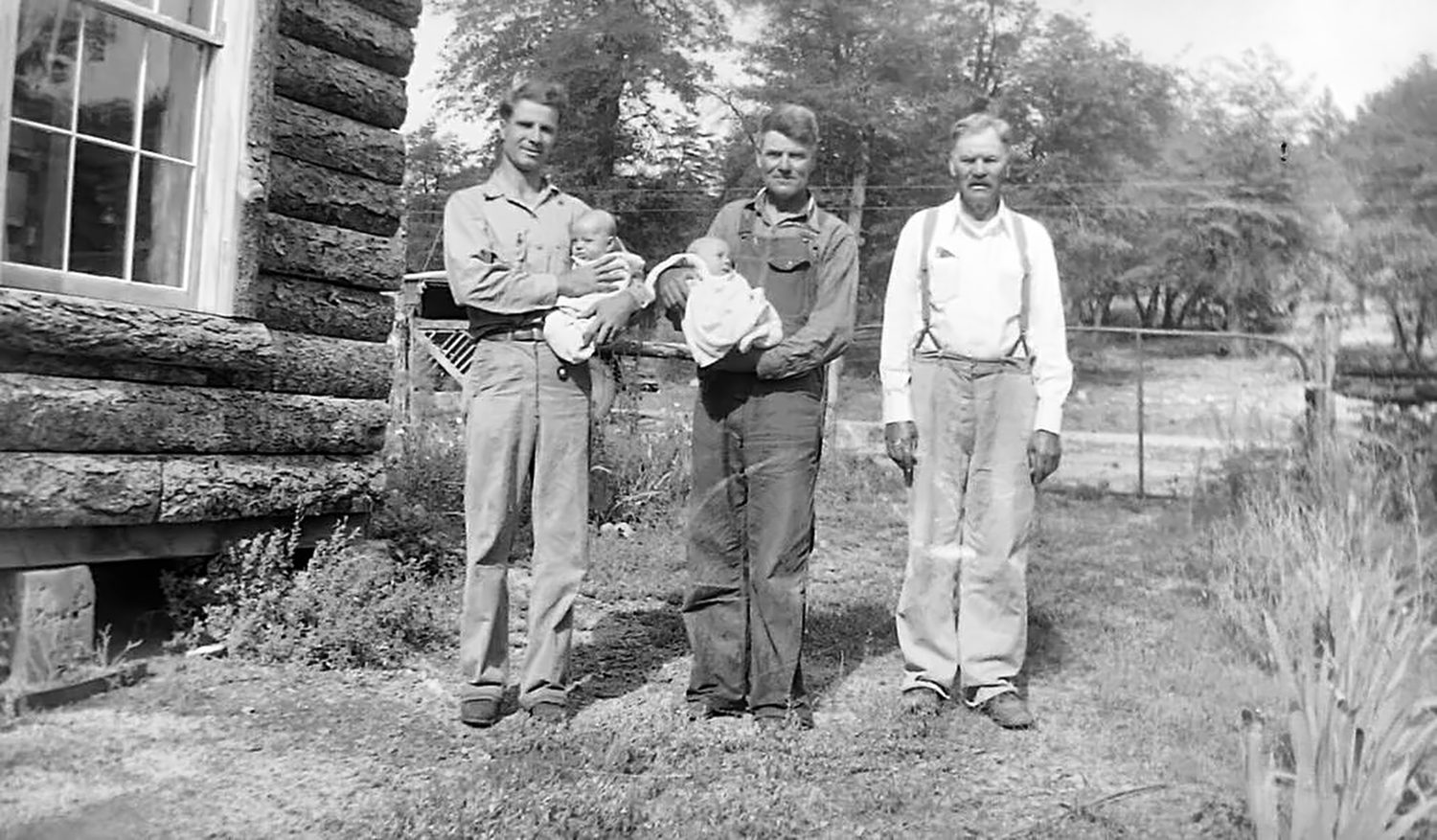
Everything above this point was written by clerks, enumerators, surveyors, and editors. In the summer of 1938, in a yard at Young, somebody in the family picked up a camera — and the family began keeping its own record. The photograph holds four consecutive generations at once: George Thomas, seventy-nine or just eighty, seated with a newborn twin wrapped in white on each arm; John Franklin, fifty-six, standing in overalls; Floyd, twenty-nine, in a work shirt; and the twins themselves, John Melvin and Marvin Charles, born June 22 of that year on the place. A second exposure from the same day, outside the log house, shows the same clothes and the same two infants with the men rearranged. Nothing is written on either print; the identifications come from the family's caption read against the birth dates — the faces agree with the dates, and the season is fixed by two babies only weeks old. The restorations were mechanical — contrast, grain, a few hundred specks of dust repaired — and nothing in the images was invented.

Four generations in a yard: an old man with a moustache sits in a chair holding two newborn twins wrapped in white; a young man in a work shirt stands at the left and an older man in overalls stands at the right, trees behind them.
  1. 1George Thomas Waldrip, seated. Born 27 October 1858, Henderson County, Texas. Seventy-nine, or just eighty.
  2. 2John Franklin Waldrip, in overalls. Born 26 February 1882, Coleman County, Texas. Fifty-six. The brand is his.
  3. 3Floyd Raymond Waldrip, in the work shirt. Born 24 February 1909, Mountain Park, New Mexico Territory. Twenty-nine.
  4. 4John Melvin and Marvin Charles Waldrip, weeks old. Born 22 June 1938, Young, Arizona. Melvin's memorial is the tape in the next chapter. Marvin was in the room.
  1. inferred

    The four identifications come from the family's caption and from reading the faces against the birth dates. Nothing is written on the print.

    family caption george-john-floyd-melvin-and-marvin-waldrip-circa-1938_2093703177; the project's note on the photographs. Writing on the back of the original would make this sourced.

  2. inferred

    It was taken in the summer of 1938 at Young, almost certainly on the homestead: the twins are weeks old and the second frame shows the log house.

    from the two files against the twins' birth date; no date on either print

  3. sourced

    This is a photograph, restored without a model. Nothing in it was generated, and nothing generated appears in this chapter.

    the family's photographs, supplied 2026-09-08 (private); restoration parameters and source checksums held with them, "generative": false; the restoration inpainted a few hundred pixels for dust; opened 2026-09-08

The same session outside a log house: the young man and the man in overalls each hold one twin, and the old man stands at the right in a white shirt and suspenders.
The second exposure, outside the log house. Floyd and John Franklin each hold a twin; George Thomas stands. Same day, same clothes, same two infants.

inferred · four-generations-again_2093708889, read against the first frame; restored non-generatively

John Melvin Waldrip

22 June 1938, Young, Arizona · to 2026

The tape · fifty-seven minutes and forty-one seconds · twelve speakers · Phoenix

"This room holds about 80 people and we were afraid that it wouldn't be big enough, because there's 80 Waldrips alone."

told · 00:54, before the service began; the family is Waldrip; the transcriber hears Waldrop throughout and the transcript has been corrected; the family's recording of the service, 3 January 2026 (private), opened 2026-09-08

John Melvin Waldrip was born on a cattle ranch under the Rim and built his life on a commercial street in Phoenix, and the public record so far has almost nothing to say about him — a birth line in the family tree, little more. That thinness is not a failure of research; it is what the paper trail of a recent life looks like while records are still closed by privacy rules and the people who knew the man are still here to talk. What stands documented is the business: Telephone Warehouse, on McDowell Road, a business-telephone company operating since 1982 — the founding year comes from the successor company's own published history. That it employed four generations of relatives rests on the family's word, said aloud in a room where a show of hands backed it up.

told Rick Waldrip 20:17 transcript only

20:17And, you know, in doing so, you know, he started a little telephone warehouse.

20:22Now, quick show of hands, how many people in this room have ever worked for, been employed for, been on the payroll of telephone warehouse, said, keep going, keep going, keep going.

20:32Yeah, look at that.

20:40And, you know, it's, for some people it was a summer job or something while they were in college. But for a lot of us, it was a career.

told · Rick Waldrip, Melvin's son, 20:17 to 20:48; machine transcript, uncorrected

  1. sourced

    Telephone Warehouse, on McDowell in Phoenix, has run since 1982 and employed four generations of relatives.

    phoneware.us/about, opened 2026-09-08: "Phoneware Cloud-Based Telecom was established in 2010 as an outgrowth of Telephone Warehouse, a business-telephone systems integrator that has served thousands of organizations since 1982." The tape remains the only source for the four generations. · https://phoneware.us/about/

told Rick Waldrip 21:54

21:54I remember one silly story about dad.

21:58He was at Telephone Warehouse and I wasn't working there at the time. I was working at CCI. But I came to have lunch with him one day.

22:05And if you all remember where Telephone Warehouse was down in McDowell, it was pretty seedy. You know, it got to be a pretty seedy area.

22:12And so I went in to pick up dad and go to lunch.

22:16And this old gal from next door, I think it was a gun shop or something, she walks in and she's just literally all strung out and, you know, missing half of her hair and made about 85 pounds.

22:28And, you know, she walks in and she's like, Mal, can I have my own $20?

22:33And dad's like, sure, whatever. You know, Sharon reaches into his pocket, gives her 20 bucks and she's like, thanks, heads back out the door.

22:41And so we're ready to go to lunch. I was like, dad, why did you loan her $20? You'll never get that back.

22:48And he said, son, everybody's worth $20.

22:59So, you know, it just, that's who he was.

23:02And, you know, he kind of ended up penniless, you know, at the end of his life. And that's because he kind of gave it all away.

told · Rick Waldrip, 21:54 to 23:09; the excerpt above is cut from the recording, AAC mono; machine transcript, uncorrected ("Mal" and "Sharon" are the transcriber's, not Rick's)

told Shannon 30:02 transcript only

30:02I think we can all agree Mel was unique and unforgettable.

30:07I'll always remember his grit, his wit, and sometimes the fact he was completely full of shit.

30:15And honestly, I think he would love that.

30:27So I think the best way to honor Mel is simple. Make someone laugh.

30:35Bring a little laughter into the world, preferably with a dash of mischief.

told · Shannon, 30:02 to 30:40; machine transcript, uncorrected. If this site needs one sentence of house voice, it is 30:07.

told Ellen Waldrip 37:18

37:18So I would be out there and play in the games, and Melvin would come out, and I'd see him talking to all the boys, you know.

37:25And I said, what is he saying? And he's saying, they said, be careful with you, you know.

37:29And it kind of made me mad, like, no, I'm as tough as they are, you know.

37:35And so I said to Melvin, I said, I'm as tough as they are. I can take it, you know.

37:41And he said, oh, I know you are.

37:43He said, I wasn't telling them for your sake.

37:46I was telling them that for their sake.

37:50And it made me feel good. I was like, all right. You know, he knew I was tough.

told · Ellen Waldrip, Marvin's oldest, the only girl among ten cousins (36:41), 37:18 to 37:57; excerpt cut from the recording; machine transcript, uncorrected

told Marvin Waldrip 39:43 transcript only

39:43I just tell you that he was a wonderful twin.

39:49Left-handed, not right-handed. Politics, we were opposite sides. We were mirror-twenties.

39:58And fights, we used to get in fights. Some guy, I remember one time, he knew this guy was going to hit him. And the guy, you didn't know he was left-handed. And he popped in so hard the first time.

told · Marvin Waldrip, his twin, 39:43 to 40:12; machine transcript, uncorrected ("mirror-twenties" is the transcriber's; the word is mirror twins)

  1. unverified

    The tree records the twins' birth on 22 June 1938 at Young, and still lists John Melvin as living.

    the family's Geni tree export (private), "1 BIRT 2 DATE 22 JUN 1938 3 CITY Young 3 STAE Arizona"; no death event; the export was opened 2026-09-07, the underlying record was not

told Ann Waldrip 42:28 transcript only

42:28But the closeness is amazing.

42:32And my father told me when I met Marvin, don't ever try to get between that.

42:39And I don't think I ever did.

told · Ann Waldrip, Marvin's wife, "Melvin's sister-in-law, many years" (40:52), 42:28 to 42:41; machine transcript, uncorrected

told Jason Waldrip 48:06

48:06Hi, I'm Jason Waldrip. I'm Rick's son and Mel's grandson. Sitting up here just hearing everyone,

48:13I'm thinking about how many pieces of Mel and Marvin just exist in all of us today.

48:20And just thinking about how much of that got passed down to my dad and Rob and everyone else. I mean, the same generosity came from both my dad and Rob. I got a start in tech because of Rob, you know.

48:35And all this generosity of putting your hand out and helping your family really comes a long way. And I'm just really grateful. I see a lot of myself in Grandpa.

48:42I have that joy, and I just love to make people laugh.

told · Jason Waldrip, Rick's son, Melvin's grandson, the man building this page, 48:06 to 48:47; excerpt cut from the recording; machine transcript with capitals and punctuation added, words untouched

The last man on the line is the one on the tape saying how many pieces of the others are in him. The direct line ends there, in a room, out loud.

The branches

Floyd and Evelyn's household, Young · and the room in Phoenix

The line down the margin is one route through this family, not its shape. Floyd and Evelyn raised a household under the Rim and the twins were two of it. The girl standing beside her mother in the first photograph below is Janice. She drove fifteen hours from Napa this year for her brothers' memorial, and her daughter opened the service. The family's own origin story, in the chapter after this, now runs through that branch and not the paternal one.

  1. Annthe older girl in the childhood print · "his big sister" (Rick, 13:24)
  2. Janicethe girl in both 1938 prints · drove from Napa (01:39) · her daughter is Diana
  3. Melvin22 June 1938 · the tape
  4. Marvin22 June 1938 · his twin · spoke at 39:43
  5. Tommydied a couple of months before Melvin · "he played in his band at restaurants and clubs" (12:13)

inferred · the sibling set is read from the family captions (evelyn-janice-melvin-and-marvin, proud-papa-floyd, ann-waldrip-temple-and-janice-waldrip-deen) and from what was said on the tape; no record of the household has been opened. Living people are named and quoted; their dates and places are not on this page.

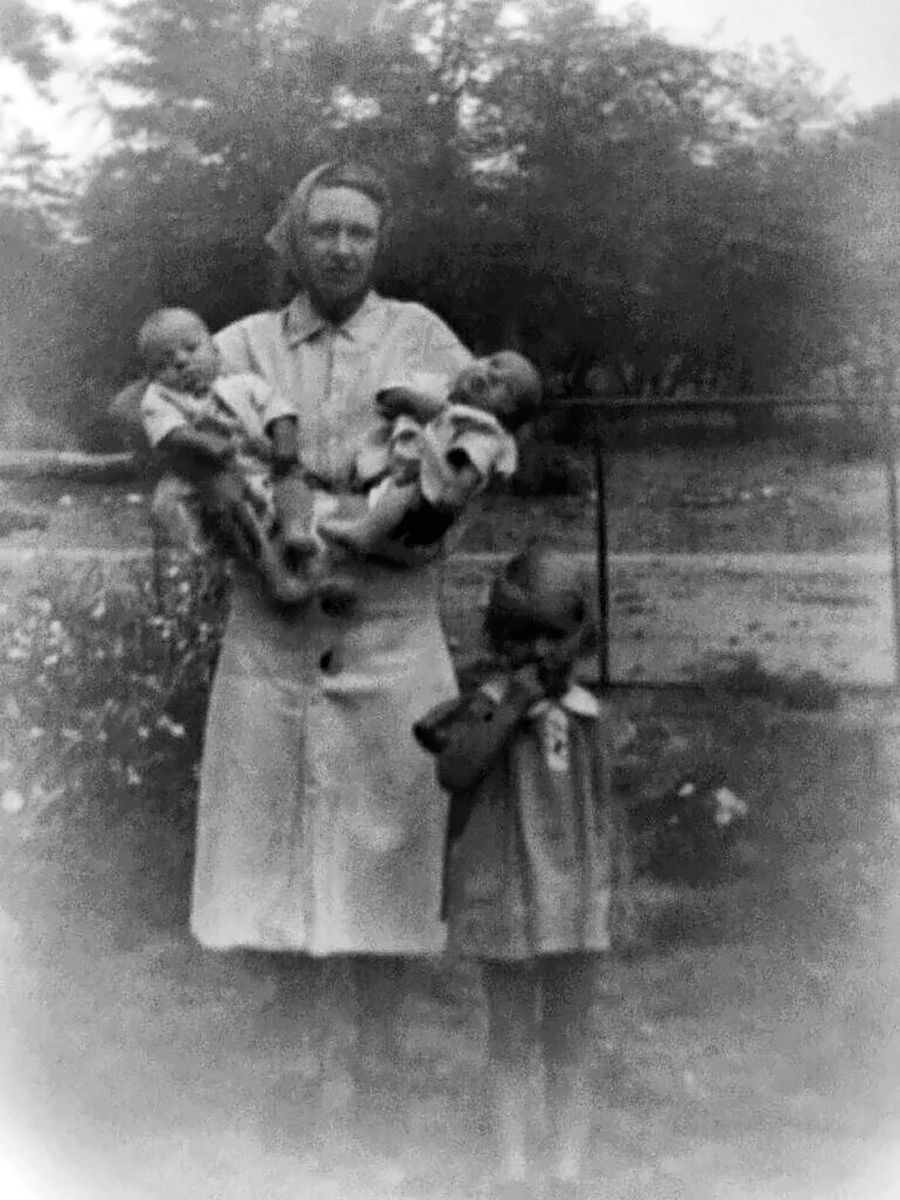
A woman in a headscarf and a light dress holds two infants, one on each arm, in a garden; a small girl in a dark dress stands at her side looking up.
Evelyn with the twins, and Janice beside her.

inferred · family caption evelyn-janice-melvin-and-marvin_2094479918; undated; restored non-generatively

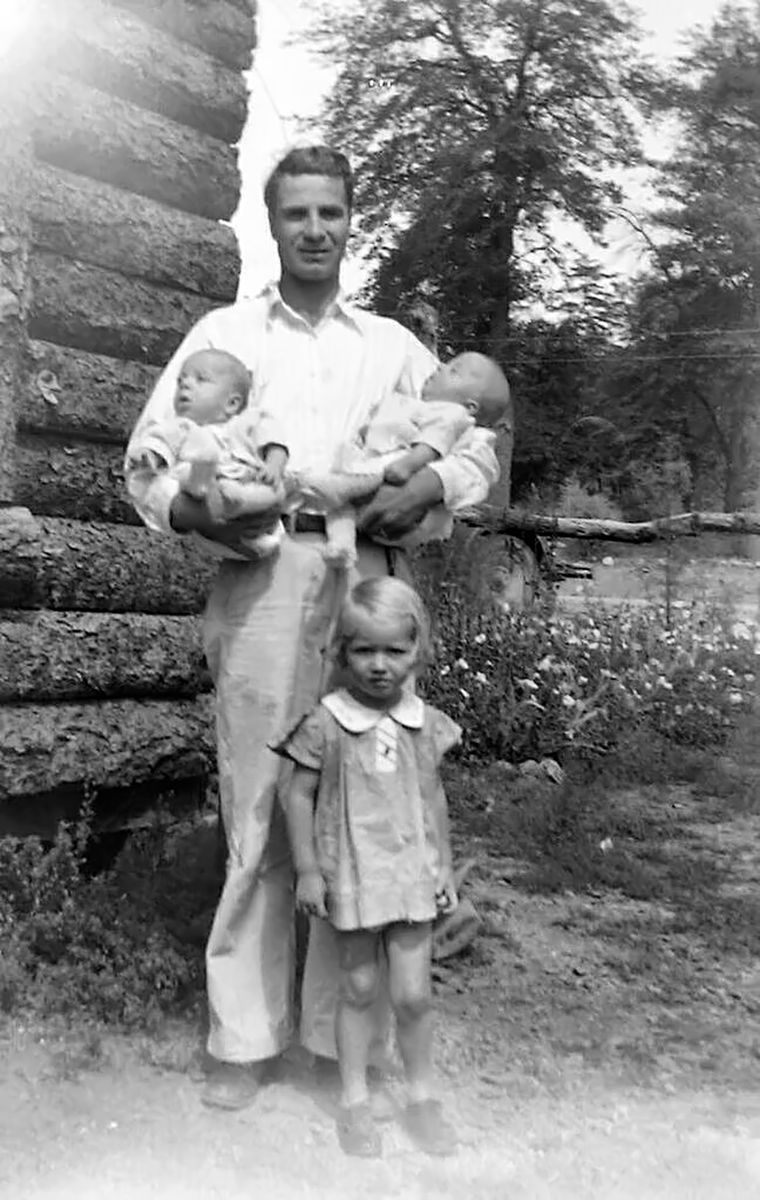
A young man in a white shirt holds two infants in front of a log wall; a small fair-haired girl in a dress stands in front of him.
"Proud papa Floyd", the caption says. The twins, and Janice in front.

inferred · family caption proud-papa-floyd_2094481956; undated; restored non-generatively

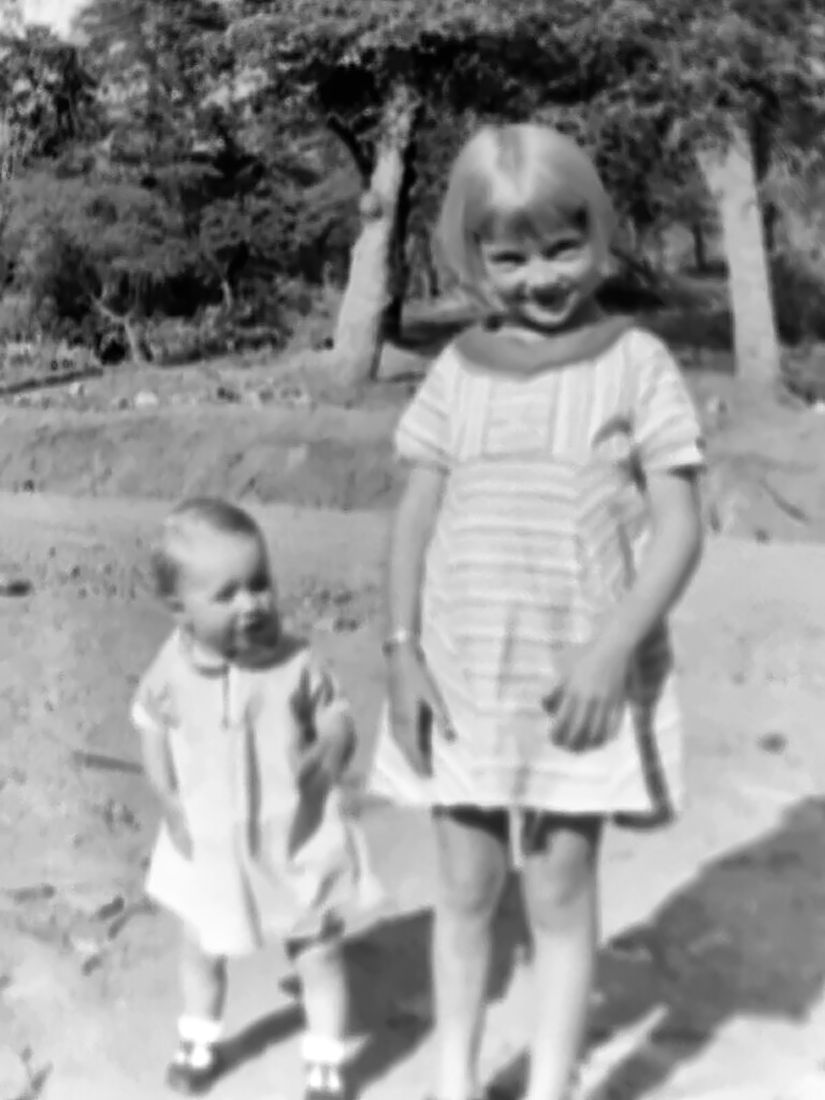
Two children on a dirt yard in sunlight: a laughing girl of about six in a striped dress and a toddler in a white smock, trees behind.
The caption reads "Ann Waldrip Temple and Janice Waldrip Deen". It confirms two married names the tape only implied, and it says nothing else, so neither does this.

unverified · family caption ann-waldrip-temple-and-janice-waldrip-deen_2094479424; undated; restored non-generatively

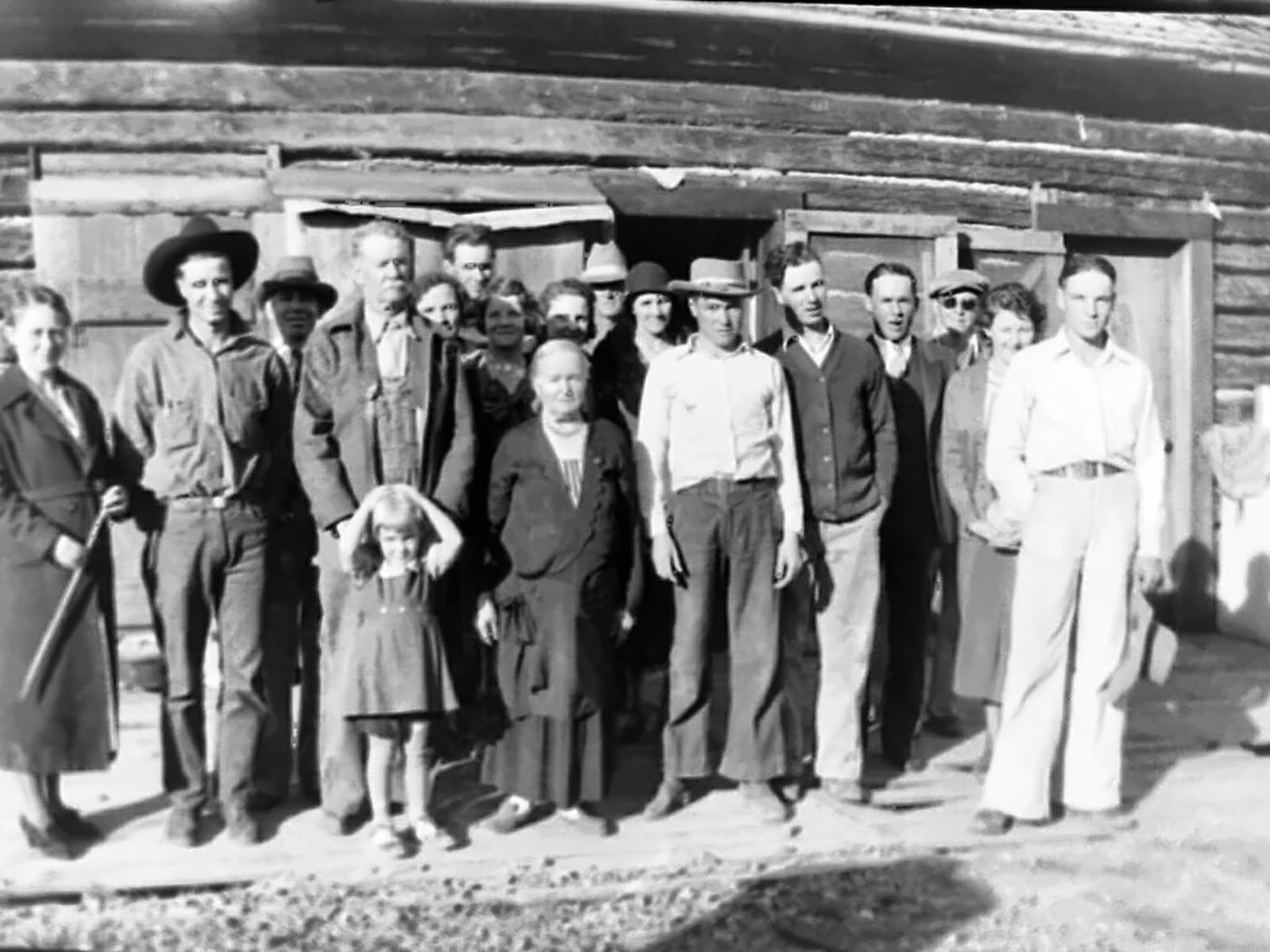
About twenty people, men in hats and work clothes and women in dresses, stand in a row in front of a long log building; a small girl in a pinafore stands at the front with her hands on her head.
"The Waldrip bunch." A log house, twenty-odd people, one small girl at the front with her hands on her head. The caption names nobody individually and the page does not either. Somebody in the room this year could.

unverified · family caption the-waldrip-bunch_2094482854; undated; restored non-generatively. A print to show Marvin, Ann and Janice while they can be asked.

The warehouse, on the tape

told Rob Waldrip 43:08 transcript only

43:08I'm Rob Waldron. I'm number three son. My dad's favorite.

44:11He got me my first job in telecom for a company called Tim's.

44:31But I'm forever grateful for the memories and then him getting me into telecom in, you know, 40 years now, today.

told · Rob Waldrip, 43:08 to 44:42; machine transcript, uncorrected. Jason: "I got a start in tech because of Rob" (48:23).

told Greg Waldrip 47:37 transcript only

47:37He just, man, so genuine, genuinely happy, you know. And I'm grateful they made a career, you know, for me as well, coming up on 30 years at the telephone warehouse.

told · Greg Waldrip, 47:37 to 47:49; machine transcript with capitals and punctuation added, words untouched

told Diana Deen 06:28 transcript only

06:28Recently, I shared a story and a message that I am the second oldest of 17 cousins just on my mom's side.

06:45But in our generation, there was a posse of us Waldrip grandkids, right? Most of whom now have their own grandkids. And we know each other.

told · Diana Deen, Janice's daughter, a deacon in the Episcopal Church (01:28), 06:28 to 06:54; machine transcript, uncorrected

Who we are, told and checked

Diana Deen, opening the service · 04:00 to 06:10 · and the record's answer to each line

Set against the documents, those eleven claims sort with complete honesty, and none of them deserves striking out. Three the record contradicts. The earliest documented man of the name appears in 1672 and 1682, not 1608, and no passenger of the second supply carries the surname in any spelling. The four famous peers span a full century — Franklin was born in 1706, Davis in 1808 — so no single generation stood beside them all. And on the family's direct line, there is no documented Revolutionary War military service — the claims of military participation found in family sheets belong to civilian records on collateral lines or unproven traditions, while no direct Waldrip ancestor demonstrably carried a musket in that war.

told Diana Deen 04:00

04:00And so I want to talk about we the Waldrips.

04:03Because we the Waldrips are people of strength and courage, vitality and vision, who throughout history have chosen to live on the frontiers of change and led progress believing in possibilities.

04:19From the beginning of our history, this family has taken risks and we've lived through amazing challenges.

04:27You know, we first arrived in the United States in the year 1608 with the second supply ship to the newly formed Jamestown, Virginia.

04:36Not long after that, our ancestors actually joined the first communities of both Massachusetts and Virginia.

04:45Our first namesake relative, Michael Waldrop, obviously that changed later on, came from Scotland through England to the New World in 1670.

04:55As a young man in his early 20s, a difficult voyage at best in a place and time of uncertainty requiring great courage.

05:06All of our relatives at that time were members of the first legislative assembly of our country.

05:12They were peers and contemporaries to people like George Washington, Benjamin Franklin, Abraham Lincoln, Jefferson Davis and others.

05:21We've been captured by Indians and escaped.

05:26We fought in the American Revolution.

05:28We bought and sold slaves.

05:31We fought in the Civil War.

05:33We served as Texas Rangers.

05:36And so we are pioneers who have traveled west in covered wagons.

05:41Marvin said the other day, we're the first generation, his generation, the first one not raised in horses, on horseback, right?

05:50We are English. We are Scottish. We are Irish.

05:53And even though it's highly remembered and yet to be proven, we are Native American too.

05:59And some of our ancestors are famous or infamous for their acts in U.S. history.

06:06And so ours is the story of America.

told · Diana Deen, 04:00 to 06:10; excerpt cut from the recording, AAC mono; machine transcript, uncorrected. The eleven lines checked below are the ones that make a claim the record can answer.

told
"We first arrived in the United States in the year 1608 with the second supply ship to the newly formed Jamestown, Virginia."

Diana Deen, 04:27

sourceddisagrees

The earliest documented man of the name is a 1672 York County tithable and the 1682 headright on the Claibornes' patent. No 1608 arrival, and no passenger on the second supply, is documented under any spelling.

Virginia Patent Book 7, p. 154, abstracted in Nugent, Cavaliers and Pioneers, vol. 2, p. 236, by three transcriptions; the project's surname research; the 1608 claim has no record behind it anywhere in the tree or the research

told
"Our first namesake relative, Michael Waldrop, obviously that changed later on, came from Scotland through England to the New World in 1670."

Diana Deen, 04:45

unverifiedunsupported

The Scottish origin traces to David Dobson's 1984 directory of Scottish settlers, and Dobson's entry rests on an unverified query sent in by an amateur. Nothing contemporary says where Michael Wardrope came from. The 1670 date is close to the 1672 levy and may descend from it.

the project's surname research; the record neither confirms nor contradicts, so the square stays open

told
"All of our relatives at that time were members of the first legislative assembly of our country."

Diana Deen, 05:06

unverifiedunsupported

Nothing found. No burgess of that name is recorded, and the family's one documented man in the period was a headright, which is what a man was called when somebody else got land for bringing him.

the project's surname research; the project's contradictions file

told
"They were peers and contemporaries to people like George Washington, Benjamin Franklin, Abraham Lincoln, Jefferson Davis and others."

Diana Deen, 05:12

inferreddisagrees

Those four men span a century. Franklin was born in 1706 and Davis in 1808; no one generation was contemporary with all of them. The family was contemporary with all four in the sense that it existed, which is true of every family.

from the dates alone

told
"We fought in the American Revolution."

Diana Deen, 05:26

sourceddisagrees

Not on the direct Waldrip line. Michael Waldrip (born circa 1770) was a child during the Revolution, too young to bear arms. His candidate father, Michael Waldrop of Spartanburg County, South Carolina, served in Roebuck's Regiment during the war, but that parentage remains unverified, and no direct military enlistment on the line has been established.

NARA and South Carolina Revolutionary records; 1790 Spartanburg census; the project's Richard Michael Waldrip research; no enlistment on the direct line

told
"We bought and sold slaves."

Diana Deen, 05:28

unverifiedunchecked

Nobody has looked. The answer is in the probate inventories of Wayne and Tishomingo counties and the 1850 and 1860 slave schedules for Smith and Henderson counties, and the page will carry whatever they say.

the project's index of the recording; no search has been made

told
"We fought in the Civil War."

Diana Deen, 05:31

sourceddisagrees

Not on the direct Waldrip line. Anderson Marion Waldrip lived as a civilian stock raiser on the exposed Texas frontier in Coleman County and has no enlistment in Confederate or Union compiled service records (NARA M323, M380) or Texas pension rolls. His sons were infants or small children during the war (George Thomas was born in November 1858).

National Archives M323 (Confederate) and M380 (Union) compiled service records for Texas; Texas State Archives Confederate Pension Application Index; the project's military service research

told
"We served as Texas Rangers."

Diana Deen, 05:33

unverifiedunsupported

The tree carries a note that George Thomas "served in Texas Rangers during Indian Wars". The Texas State Library's Ranger rolls index no commission for him. If he rode, it was with a frontier posse in the 1870s, and a correction to retract the note is pending.

TSLAC Texas Ranger service records, no entry; the project's pending corrections list corr-20260908-035; the project's military service research

told
"And so we are pioneers who have traveled west in covered wagons."

Diana Deen, 05:36

unverifiedagrees

The route is in the record, county by county, and chapter III draws it. What they travelled in is not recorded anywhere.

the project's migration research; the wagons are the family's

told
"Marvin said the other day, we're the first generation, his generation, the first one not raised in horses, on horseback, right?"

Diana Deen, 05:41

unverifiedagrees

In 1930 John Franklin is a stockman and Floyd a labourer on a cattle ranch at Young. Anderson raised cattle on the Colorado in 1870; George Thomas was a cattle raiser at twenty-one. The twins were born on that ranch in 1938 and Floyd later worked as an operating engineer in Phoenix.

1870 Coleman, 1880 McCulloch, 1930 Young census rows; Floyd's death certificate, 1976; none opened

told
"And even though it's highly remembered and yet to be proven, we are Native American too."

Diana Deen, 05:53

unverifiedunsupported

She states the epistemics herself, and the page agrees with her statement. Two Cherokee notes in the tree have nothing behind them; the 1830 to 1880 censuses enumerate Anderson and his parents as white; no Indian roll, agency record or vital record carries it. It stays on the page as what the family remembers.

the project's research on this man; the project's migration research, dead end 4; corrections pending as decisions, not edits

Eleven claims: three the record contradicts, four it cannot support, three it agrees with, one nobody has checked. None of them is struck out. She was not wrong to tell it, and the family is the only one of the two registers that can still be asked a question.

  1. agrees an opened or cited record carries the substance of what was said
  2. disagrees a record contradicts it
  3. unsupported no record has anything either way, or the only known source is worthless
  4. unchecked a record would answer it and nobody has opened one

The gate · what it protects and what it does not

Are you one of us?

Everything above this line is open: the names, the photographs, the stories, the record and the telling. What the gate protects is the data of the living, meaning dates, places and how to reach people. What is here is the researched history of the dead, down through the sixth generation (the children of Floyd and Evelyn Waldrip: Melvin, Marvin, and their siblings). Records, dates, and photographs of living generations are kept private.

If you are a family member looking to connect, inquire about living records, or share what you know, you can reach out directly:

Connect or contribute to the archive

Research archive · living family records are private. Use the contribution form to share recollections, records, or inquiries.

The entry to all of this · sharing stories

Tell one

Every story on this page arrived the same way: somebody stood up and said it, and somebody else wrote down who and when. This is where the next one comes in. Say it in your own words. It will be transcribed, marked told with your name and the date, checked against the record where the record has anything to say, and both will go on the page.

What happens to contributions

  1. It is kept with your name and date, as a telling.
  2. Where public records can corroborate or add context, they are placed alongside.
  3. New records and verified additions are added to the archive with each update.

Contribute a story, recollection, or record

Family contributions · submit stories, memories, or photographs through the contribution form for inclusion in the family history.

The last mark, so far

In 2026 a Michael Waldrip wrote a song

This history opens on a Michael Waldrip who could not write his name. A Tennessee clerk wrote it for him in 1821, and again in 1827, and again in 1832, and each time he set a mark beside it whose shape nobody thought to record. Two days after the memorial service, the family published a video in Melvin's memory, and under it ran a song, "It's a Lonelier World," credited to another Michael Waldrip — read naturally, Marvin's son, Melvin's nephew, seven generations down the same line. No one asked for it; he simply wrote it. From a mark a man could not read, to a brand burned in a man's own initials, to a photograph of four generations in a yard, to an hour of voices on tape, to a song under the family's own name — the line that spent two hundred and fifty years in other people's ledgers is keeping its own book now.

"It's a Lonelier World" · written by Michael Fitzgerald Waldrip · 4 minutes 16

sourced · In Loving Memory of John Melvin Waldrip, published by the family on 5 January 2026, channel Mike Waldrip; the description credits the song to Michael Waldrip. Audio lifted from that video and archived locally with its checksum. That the credited writer is this Michael is the obvious reading and is not stated anywhere.

  1. sourced

    Michael Fitzgerald Waldrip, born 23 March 1964, is Marvin's son and Melvin's nephew.

    the family's Geni tree export (private), guid 6000000000613332001; his siblings Ellen, Greg and David all speak on the recording above

Report a problem on this page