2 T Ranch
Since school was in session only about nine months each year it was possible to work the other three and that is just what I did. I spent a number of summers working for Orville Hazelwood on the ZT Ranch. Orville came from a large family and I attended school with two of his sisters and one of his brothers. I was well acquainted with his family. Orville did not have a good reputation among other ranchers. After coming to Young from Texas in 1911, Orville and his two brothers homesteaded the PB Ranch on lower Cherry Creek and proceeded to build up a herd of cattle. They did this by finding unbranded animals which were a year or more old and then putting their brand on them. Technically, any cow a year or more old and which was not branded was a "maverick" and was fair game for anyone who wanted to brand her. Reasonably, if you owned only twenty or thirty cows and you branded fifty "mavericks" you were stretching the custom by quite a margin and you were looked on with suspicion by neighboring ranchers. This is what happened to the Hazelwood brothers. They built up a large herd in a very short time by riding with a "long rope and a hot iron."
One time a State Cattle Inspector asked me to keep an eye on Orville Hazelwood and let the inspector know if he did anything that was not on the up and up. I was not about to spy on a man who had given me a job. Furthermore, Orville's actions were open and above board in every way and he was a fine "Boss."
I have always been puzzled by the fact that Orville liked me. He was a big rugged two hundred pounder and was a tough guy to stay with when chasing wild cattle in rough country and he could throw a rope on an animal in impossible spots but could not rope anything in a rodeo roping contest.
Orville bought a horse from an itinerant horse trader one summer and the horse turned out to be an outlaw. On one occasion he was trying to break the horse and was riding him in a large corral. The horse bucked into the fence and fell on top of Orville who then grabbed the horse's head to hold him down I ran in and managed to get Orville's legs out from under the horse. It was then that I discovered that Orville had a dislocated shoulder which I managed to get back in place and with his arm in a sling we continued to work with the horse. He was a tough guy.
Orville had a young sister who was about my age and one summer he left me alone at the ranch and went to see his sister in Phoenix because she was ill. Unfortunately she died and when Orville came back he insisted that I conduct her funeral service at the local church. He had never had anything to do with a church but he knew the local preacher and felt that he was not acceptable. I went to my Dad and we found some appropriate verses of scripture to use. I asked my good friend, Ernest Cline, to join me in a duet and with those and a few personal remarks, that was the ceremony. Orville was most appreciative.
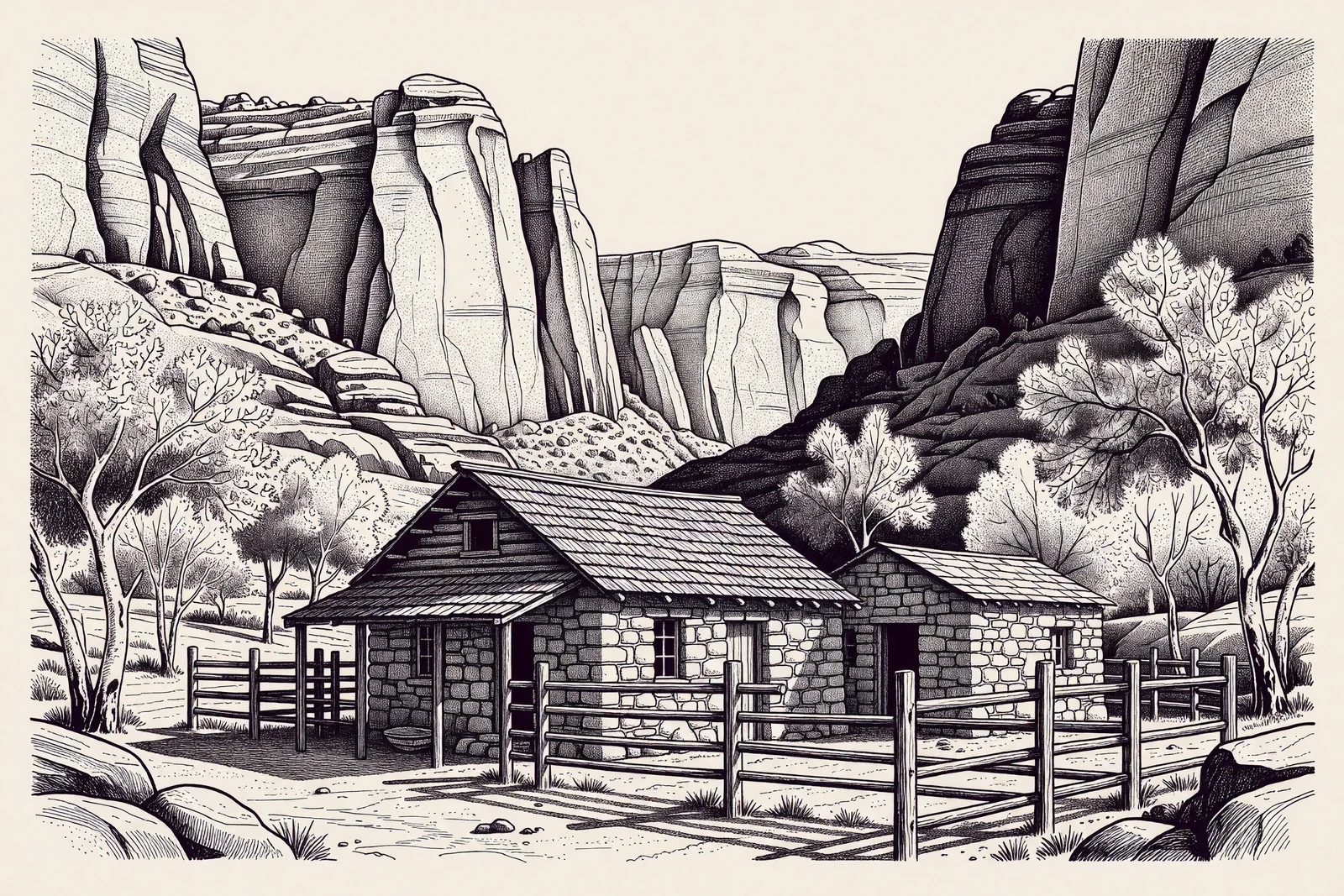
The ZT range ran down Cherry Creek a good day's ride from Pleasant Valley and the PB place was in a wild canyon west of Cherry Creek. There was a one-room cabin, a store room, corrals and a horse pasture. There was also a nice spring which supplied drinking water. I usually came home from school after the ranch work began and would pick up my string of horses at the ZT Ranch in the Valley and join the crew at the PBs. Orville always left my horses at the home ranch and I would ride one, pack one and lead the others to the PBs.
The crew I joined was always a real mixture of people. One year we had Ky Wilhoit from Texas but most recently from Hollywood where he had played parts in some western movies. Ky loved to sing and kept the outfit entertained with his many interesting songs. In the 1970s Ky had some land in Glendale, California and was furnishing cattle, horses, mules and buffalo to the movie studios for use in filming movies.
We also had Jack County, all five feet of him. Jack was an orphan. He had been born in Texas and was found in a basket on the front steps of the court house in Jack County Texas which accounts for his name. Under the circumstances, he was a ward of the county and they gave him his unusual name. Besides being so short Jack had a very prominent nose which was always getting broken and was therefore very crooked. He could not sing but he could ride, rope and tell great stories. He was flanking calves one day in a rocky canyon and managed to let a big calf break his nose again. It did not phase him. He just kept on working.
Another crew member was Jesse Ellison who was a genuine cowboy and the most reckless rider I ever saw. Jesse was married to the sister of George Hunt, the first governor of Arizona. Jesse was the son of Colonel Ellison who owned the Q Ranch for many years and about whom there were many stories. Jesse said he left home at the age of eleven because his father was so mean and cruel. He was raised by the Apache Indians. The Lupe Family of Whiteriver considered Jesse to be a member of their family.
When Jesse was working on a ranch he was never given a good horse to ride because he was so reckless he might break one of the horse's legs. It was no different on the ZT. Jesse rode the poorest horses in the outfit. One day we were riding on Squaw Peak Mesa when a bunch of wild cattle jumped out of a thicket. Jesse Ellison immediately took after them. The cattle just dived off the edge of the mesa and Orville yelled, "Let 'em go!" Jesse paid no attention to Orville. He was right on the heels of the cattle as they went over the edge of the mesa. The rest of the crew went to the trail that zig zagged down an extremely steep mountain side. At the bottom was Turkey Creek and when we got there Jesse had all the cattle in the corral and was sitting on his horse in the gate. No mountain was too steep and no cattle too wild for Jesse Ellison.
We had riders from adjoining ranches riding with us because there was always some stray animals mixed in with ours. R. M. Grantham rode with us on many occasions. R M owned the Q Ranch and I remember his plaited rawhide rope particularly well since it was sixty feet long. R M was a "dally man." The rest of us used thirty to forty feet of cotton, nylon or hemp rope and we tied it solidly to the saddle horn. R M would throw his loop and then wrap the loose end around the saddle horn (dally) to stop the animal he had roped. The rest of us did well to handle thirty feet of rope but R M could use all sixty feet of his.
Another guy who rode with us was Wiley Lacy and he was a most picturesque cowboy. Wiley was about six feet three with broad shoulders and slim hips. He had black curly hair and bright white teeth. Needless to say all the women looked at Wiley at least twice.
Bus Ellison, Jesse's brother, rode with us now and then. Now Bus was as homely as Wiley Lacy was handsome and here in lies a story I heard about the two of them. It seems that Bus and Wiley were working at the Q Ranch for R M Grantham and R M had a pretty young wife about whom he was greatly concerned because he thought something was not right at home. He gave considerable thought to his two hired hands, Wiley and Bus. He finally reached the conclusion that no woman would look twice at Bus Ellison because he was so ugly, so he fired Wiley Lacy. The next day Bus and the wife left together. She got a divorce from R M and married Bus. Certainly in this case R M's judgement was faulty. I have heard Bus joke about stealing calves from R M but I'll bet he did not joke about stealing his wife.
Other crew members at the ZT included Johnny Yeager who was a stubborn Dutch boy about my age. Oscar Reed was from Holbrook and he always took his pay in cattle since he was trying to build up a herd. Si Garlinghouse rode with us a few times and he was expert in handling mules or horses. Orville had a pack mule which had to be blindfolded in order to get a pack on him. Si took this mule in a large corral and put strong hobbles on his front legs. He then tied the front legs to a rope which was anchored to a hitching post in the center of the corral. Si picked up a saddle blanket and ran at the mule which tried to get away. When he hit the end of the rope he did a complete flip, landing on his side. When the mule got up Si ran at him again and he did another flip. After eight or ten times the mule refused to move when Si ran at him. After that experience, when we wanted to pack the mule we just placed a rope around his front legs and he stood stock still and gave no problem at all as we packed him.
Si Garlinghouse was a middle aged man when I knew him in the 1920s and 1930s. He was unable to work effectively in the early 1940s and was living outside Globe. He and Bob Penrod were both in the camp and both were drawing a small monthly check from some State Relief Fund that had begun in the Depression. When the Second World War began in 1941 and nearly all the young men left for the armed services, both Si and Bob went back to work on ranches. They felt this was their contribution to the war effort. When the war was over both men lost his job and the small relief program on which they subsisted had been terminated. I was told that these two veteran cowboys literally starved to death at their old camp site outside of Globe, too proud to ask for help and trying to make it on their own. They were old and crippled and worn out. When they were unable to get proper food they became ill and died. I have always been saddened by the memory of these two men who were so dynamic in their productive years but were deserted by their friends and neighbors when they became old and helpless. Maybe their fate is typical of those who hang on until the end of an era and have no place to go at the end. Certainly Bob and Si were among the last of the "Real Cowboys."