Douglas Aircraft
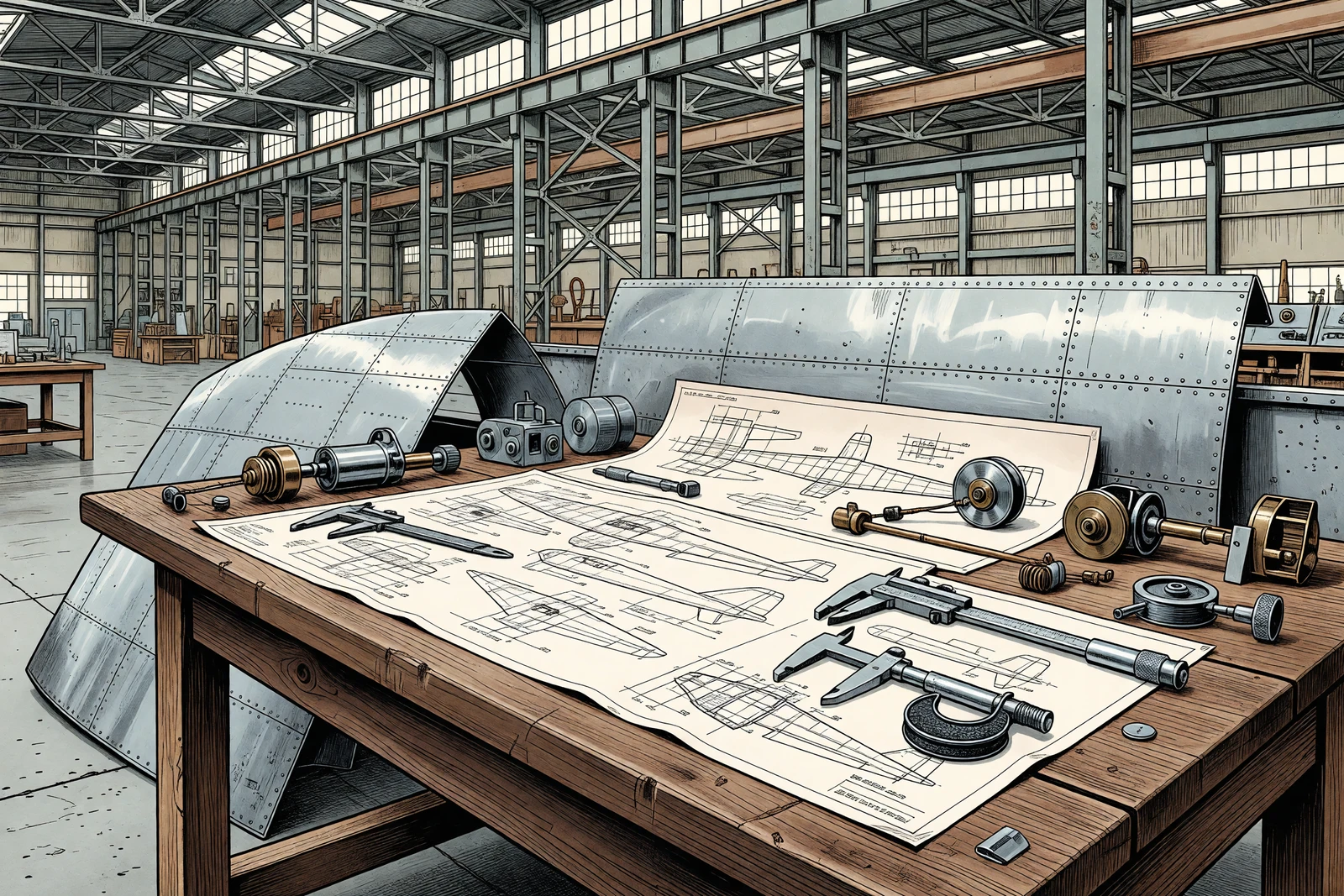
The aircraft industry was trying to gear up for mass production in 1941. The country had a few planes that could fly as far as Hawaii but those were passenger planes and we had only about a dozen or so. Douglas was building twenty light bombers for the French, ten DC3 passenger planes for Hawaii Airlines, one heavy bomber known as the B19 and was just beginning to assemble the first DC4 cargo planes for the U. S. Air Force.
I went to work in Production Control and was assigned to Department 12, a large sub-assembly operation that was responsible for producing small assemblies that served as flight and motor controls on all the aircraft being built at the Santa Monica plant. There were also landing gear components and other vital assemblies. We furnished some 90,000 parts per week to the assembly lines.
Now the pace at Douglas in the summer and fall of 1941 was not very brisk. There were many arguments among employees about the merits of the Russians vs the Germans. Most people seemed to feel that we were not going to be involved in the conflict. I felt much different. I was convinced that we would become active participants very soon and it was apparent that we were not ready. There was a steady turnover in personnel at Douglas as young men were called into military service and older men came in to replace them.
The Japanese resolved all doubt about what we had to do when they bombed Pearl Harbor on Dec. 7th 1941. We immediately went to work in earnest. We blacked out all the factory windows. We camouflaged the buildings and the airfield. We ripped the fancy "tourist" decorations out of the DC3s on the assembly line and installed extra gasoline tanks in the baggage compartments so the planes could fly to Hawaii with full loads. We then opened factory jobs to women and they flooded the place. I had the job of training some of the first women working in the shop departments and they were enormously productive. Most of them were mature middle-aged women who had a husband or a son in military service and were determined to do everything they could to help the war effort.
I had been promoted to Lead Man in my department and we needed help on the loading dock where a lot of heavy materials had to be handled. As an example of the man power shortage, when I put in a request for thirty additional employees, I received two. One of them was sixty eight years old and the other was a man with only one arm. I always resented those young soldiers who were sitting on top of the factory "protecting" us. I did not like the "guards" at all the bridges on Highway One either. We were very short of workers and we wasted a lot of man power that could have cured the shortages.
I often considered quitting my job and enlisting in the military. I was never drafted because I was "frozen" in my production position. When I saw unproductive assignments occupied by the "guards", I simply could not justify leaving the factory and possibly going up on the roof as a worthless guard.
I previously mentioned the DC4 planes as being on the assembly line. When the first one took its first test flight, a flood of two thousand change orders hit the plant. This meant that we had to revise and rebuild two thousand things we had already done because they showed up as inadequate on the test flight. In normal times those planes would not have been on the assembly line until after the first test flight. In war time there was not time to await the test flight. Planes were badly needed.
We finally finished the light bombers and crated and shipped them to the island of Martinique in the Caribbean. This happened about the same time as Germany overran France. I never heard what happened to those planes. The B19 flew and many of its best features appeared in the B29 bombers which bombed Japan a few years later.
Meanwhile our assembly lines became loaded with C54, C47 and R5D planes. These were all cargo aircraft. Our parts shortages began to clear up and our planes left in a steady stream for action all around the world. We really began to move planes and those planes along with other production began to make themselves felt on all war fronts.
Early in the war, there was great concern that the Japanese would strike the West Coast so we kept everything blacked out. No windows were showing light at night. No street lights were on and even traffic lights were not allowed to function. Automobile traffic was, at a minimum as we were conserving gasoline. Every effort was going into the production of the tools of war.
I had worked seven days a week, ten hours a day for almost two years when I finally got a day off. We took the baby and drove to San Diego, checked in at the U S Grant Hotel and I sacked out on the bed for a nap. When I awakened I was ill with what turned out to be virus pneumonia. This really knocked me out for two weeks and when I returned to work I was unable to climb one flight of stairs to my office without resting halfway up.
Even though the war was still raging in Germany and Japan we had virtually satisfied the great demand for airplanes and the pressure had lessened a great deal. I decided to take a job working on an experimental plane being built in the hanger formerly occupied by the B19. This was the "Big Hanger." At that time there was much speculation about jet propulsion but little was known about it and our engineers were rather skeptical of its practicality. They wondered how stable a plane would be if it was propelled by a strong jet in its tail. Would it begin to spin out of control? Our experimental plane was designed to test that stability. It was powered by two liquid cooled Allison engines mounted side by side between the wings with two drive shafts going to a gear box in the tail. Behind the gear box was a pair of three-blade counter-rotating propellers. There were bombays and racks underneath the big twelve cylinder engines. The landing gear was designed to fold into the side of the fuselage preserving the integrity of the wing's air foil. It was a very advanced design and drew much attention from aeronautical experts around the country.
My job on this project was to assemble and install the motor and flight controls. It was not a complicated job since all the castings and brackets had been drawn by engineers. I had to get the castings machined and put in the pulleys for control cables and then install the castings in the plane. The brackets had to be drilled properly and then installed with pulleys. Cables had to be measured, strung, cut and the ends swaged on. There were also motor and flight control levers to be installed in the cockpit. All operations were supervised by an engineer.
All this work was interesting but it was very slow going and there were many times when there was nothing to do but wait on a decision from an engineer so I began to think of doing something else. Finally in the summer of 1944 I informed my Draft Board that I was ready to go into the Military and if I was not needed there, I intended to return to teaching. They replied immediately and told me that I was needed worse in education than in the military and they urged me to return to teaching. I had taken some management courses at UCLA so I went to that campus and located the head of teacher placement, a Dr. Aubery Berry. I told him that I wanted to get as far from Los Angeles as I could but that I had only enough gasoline to go about one hundred miles. The following Saturday I interviewed Frank Bishop, Superintendent of schools from Corona in Riverside County. They needed a coach and physical education teacher and I took the job.